Showing posts with label preschoolers. Show all posts

November 13, 2011

I want my hat back

This is perhaps the best picture book I've seen all year. And I don't say that lightly - a LOT of picture books come across my desk. But occasionally there's a gem that reminds me why I love children's literature so much.

The plot is deceptively simple - Bear is looking for his little red pointy hat and talks to many animals in his search - but the text is masterful, pitch-perfect, and laugh out loud funny. This last claim has been laboratory tested, at least on adults: I walked around the office and made my coworkers read the book and watched them all pause for a couple of seconds at the end and then gasp and laugh.

Have I not mentioned the illustrations yet? I would frame this whole book and put it on my wall. The illustrations are simple, nuanced, funny, mostly understated and absolutely stunning. And even the book design is an integral part of the pleasure of this picture book - the text design (font, size and colour) interacts subtly with the storyline in a pleasing way, the pages are beautifully laid out, and the colour scheme is restrained in a way that makes colour use sing with meaning. What's amazing to me, though, is that this is the first picture book where Klassen has moved from being an illustrator (of great talent) to an author-illustrator. This is not an easy transition, and I've seen it go poorly more often than not. So colour me surprised and impressed - there are only a handful of truly great author-illustrators alive today, and I think this book makes Jon Klassen a force to watch out for.

If you have an older preschooler in your life (a mature 3 year old, a 4 - 5, or even 6 year old?) who enjoys animals, great illustrations, and doesn't mind a bit of morbid humour, this is the perfect present. Even though the text is very simple, I suggest it for preschoolers instead of toddlers because the humorous finale does take a bit inferring power to understand. Spoiler - if you are morally against a bit of implied animal-on-animal violence, this is not the book for you.

Oh, and did I mention that Jon Klassen is Canadian? This one's going to win some awards. It's almost not fair that Klassen's recent picture book illustrations for Cat's Night Out won the GG in 2010. If I was on the committee, I'd find it hard not to to give that award to him again.

June 24, 2011

Press Here!


In France, Herve Tullet is know as the King of Preschool. Press Here (Chronicle Books, 2011) is his latest picture book - and what a hoot! At first the series of coloured circles and written instructions (press the yellow dot, shake the book, clap twice, etc.), might not seem like much, but add kids to the mix and watch the magic happen. I could keep describing, but wouldn't you rather watch kids play? CLICK HERE for the video trailer!

And see Herve Tullet in action here - great stuff: "There will be three people. I will be in the middle in my book. And there will be a child. And there will be someone who knows how to read the book. And I hope everybody could play with the book. The child could play, and the adult could play too."

June 23, 2011

Book reviews for the Early Childhood Educator

My latest book review column is out in the Early Childhood Educator journal. Unfortunately current content for the journal isn't available online, but you now see older articles including one of my earlier book review columns called: Let Children Take the Lead with Wordless Books.

This month's theme is Aboriginal childcare, and my column features some of my favorite Aboriginal pictures books including:


Zoe and the Fawn, written by Catherine Jameson (Shuswap/Okanagan/Syilx), illustrated by Julie Flett (Métis)


The Little Hummingbird by Michael Nicoll Yahgulanaas (Haida)


Lii Yiiboo Nayaapiwak Lii Swer: L'alfabet Di Michif = Owls See Clearly at Night : a Michif Alphabet
. by Julie Flett (Métis)


Learn the Colours with Northwest Coast Native Art (and other titles in the board book series), created by Native Northwest Educational Resources


Shi-shi-etko by Nicola I. Campbell (Interior Salish/Métis), Illustrated by Kim LaFave


I also talk about the BC Aboriginal Child Care Society and some of their excellent lending resources. If you're in British Columbia, check them out. They have lots of valuable resources developed for Aboriginal child care centers, including ECE curriculum boxes which can be borrowed for use in circle time or other activities. Their "Moe the Mouse" speech and language development program is a fabulous resource developed by two speech-language pathologists for the BC Aboriginal Child Care Society. Rather than singling out children who have difficulty making certain speech sounds, and focusing on repetitive “corrective” or “teaching” exercises, this program uses an appealing mouse character to present fun speech and language activities to an entire circle time group, with a focus on aboriginal content. Children who need extra help get a fun supportive low-pressure atmosphere to practice their sounds, and everyone has lots of fun. We recently had the training at our library, and my colleagues who use this in their outreach programming report that the kids love Moe!

Check out the journal article for more information on these books and resources.

November 8, 2009

Just when you need some rocket-powered unicorns to make it through the day...


An Awesome Book by Dallas Clayton

And it really is! This self-published gem came to my attention last year at the BCLA conference, courtesy of a fellow children's librarian. The story is all about dreaming big, and it's perfectly lovely, but the illustrations are what blow the roof off my popsicle stand.

The spread of pink rocket-powered unicorns (variously wearing basketball jerseys, scuba gear, or riding mini-skateboards) is worth the price of admission alone:


You can see the entire book online here, but this is a book worth holding in your hands. I think it could have ended about half way through (the rhyming verse gets a little long-winded and didactic near the end), but it still steals my heart every time I lay eyes on it. Check this one out for sure. And if you just want to look at rocket-powered unicorns all day, you can even buy the poster here. And while you're shopping, check out the cause that your purchases support. Very cool all around.

September 1, 2008

Mrs. Chicken and the Hungry Crocodile


Pay, Won-Ldy and Margaret Lippert. Mrs. Chicken and the Hungry Crocodile. Illus. by Julie Paschkis. Henry Holt and Co., 2003.

When vain Mrs. Chicken strays a little too close to the river while trying to look at her reflection, she gets snapped up by a hungry crocodile. Held captive on an island in the river, she uses her wits to convince the crocodile that they are sisters. And sisters don't eat sisters for dinner. Talking animals, great dialogue, hatching babies, trickery, sharp teeth, and a gullible predator - this book has it all. The illustrations are stunning - simple stylized images in a limited range of bold colours - and the pages are beautifully designed with plenty of white (or black) space.

I've been doing a bunch of kindergarten outreach, and this retelling of a folktale from Liberia is one of my all-time favourite read-alouds for this age group. I'm not exactly sure why, but it's one of those magic stories that slowly makes the room go quiet. There's nothing quite like a room full of rapt five-year olds to make you appreciate a book even more than you did before. The story is plenty funny, with room for fun voices and many laughs, but it doesn’t depend on obnoxious or ridiculous humour to entertain; it’s just masterful storytelling. The text is complex and has enough tension to keep 5, 6 or 7 year olds interested, but is also accessible enough to read to a family storytime group with a mix of toddlers, preschoolers, and school-age children.

June 2, 2008

A new review at CM


I'm still here. Really! I've just been laying low as I started an excellent new job as a children's librarian. I hope to resurface soon.

My latest review is up at CM Magazine for Colors! ¡Colores! It's a quiet but truly beautiful bilingual picture book that reads like poetry - in a good way. And that's something I don't say lightly. And the watercolor illustrations - simple, exquisite, whimsical, wow! Check it out.

Also in the latest edition of CM, one of the most unusual takes on a color concept book I've come across: The Black Book of Colors. This picture book describes colors by texture, taste, smell and sound, with both text and braille. The illustrations are rendered entirely in black with raised black lines. I'm intrigued. Can't wait to get that one in my hot little hands.

March 11, 2008

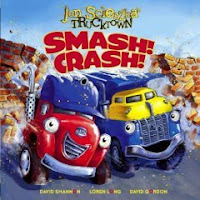
Smash! Crash!


Scieszka, Jon. Smash!Crash! Illus. by David Shannon, Loren Long and David Gordon. Simon & Schuster, 2008.

I've been stashing this book in the bottom of my storytime box with the same way one might hide a stash of tiny bills in their shoe during a serious game of monopoly. And yesterday, on an antsy rainy day, when over half of the kids brought their pet trucks to storytime, I knew its time had come. Our library has an entire section of picture books called "Things that Go" - planes, trains, race cars, garbage trucks, etc. - and the things circulate like crazy. But it's often hard to find one that will hold up as a read-aloud story. Some are pure poetry, in the tradition of Donald Crews' Freight Train, but most follow the plot of "let's go visit the fire station" or "gosh, there are some really big trucks out there." So when Smash! Crash! showed up on the new books truck, I nabbed it right away. This is the first in Jon Scieszka's Trucktown series, and it features the two best friends Jack Truck and Dump Truck Dan who like to, yes you guessed it, smash and crash. This habit tends to get them into trouble but, when Rosie the Wrecking Crane needs help, who better to call on than our two trouble-making friends?

Within seconds everyone was listening intently, and crowding onto the mats up front. Even the pet trucks were still. It's a great read-aloud with the possibility for fun voices, repeating lines, loads of action, charismatic truck characters (who presumably will each take centre stage in later installments of the series), energetic illustrations and, best of all, it's actually got a story to it. There was a minor riot to manage as kids rushed for the book after the last song, and at least one hold placed on the spot when no other truck book on the shelf would do. When I walked by the story room an hour and a half later, a handful of kids were playing a rousing (yet oddly respectful) game of "smash and crash," and the kid who had signed out the book was still carrying it possessively under one arm.

I had a little moment when it seemed like the only two obviously girl trucks were playing pirates while all the other trucks were doing real-world jobs, but the appearance of a very tough Rosie the Wrecking Crane put those reservations to rest.

This series is a book marketer's dream: content (trucks! construction! smashing!) that sells itself, a series of high-energy recurring characters (and animated truck characters at that), a children's author who is practically a household name (Jon "rhymes with Fresca" Scieszka), and a team of illustrators who are no light-weights either. In a time when children's books are not exempt from the machinations of brand recognition, this series has what it needs to succeed. But it's nice to see a series that draws on the creativity established children's writers and artists rather than using TV programs for instant branding to sell books with minimal content.

As a girl with a pickup truck of her own, I'm thinking this book will go far. Perhaps too far for my own taste, actually, with a 52-book series already planned, and TV and other media spinoffs in the unspecified future (see the Publishers Weekly article here)... So I'm planning to enjoy it now while Trucktown is a book series and not yet an empire.

March 6, 2008

Another book from the Serendipity Conference...


Einarson, Earl. The Moccasins. Illus. by Julie Flett. Theytus Books Ltd., 2005.

There is no lack of picture books about unconditional love (Mama Do You Love Me? and Love you Forever jump to mind) but, done well, it isn't something I get tired of seeing. How often, though, do we get stories of unconditional love set in a foster family? Luckily this is not only a book the world needs, it is also a charming, well-written and generally appealing book. The Moccasins tells the story of a child whose foster mother gives him a gift of moccasins to help him feel proud of his Aboriginal background. Much in the way children are able to grant special powers to toys (the Velveteen Rabbit) or blankets (Linus), the moccasins make physically tangible the love, pride and comfort that the boy's mother offers him with this gift. And somehow Einarson, with the help of illustrator Julie Flett, is able to transfer some of the magic into this book so that the object of the book itself seems immensely comforting. The text is simple and straightforward, with very few linguistic tricks, but it is unexpectedly moving. The love and care pictured in this particular family might not reflect the experience of every child growing up in a foster family (or any kind of family for that matter), but that is doesn't mean this is any less of an essential book. The fact that it is based on the author's own experience might be part of what makes it moving - or perhaps it's just a good story.

And Julie Flett. Wow. I tell you, this is a woman to watch out for. Her computer-aided collages combine a spare playful contemporary aesthetic with the kind of emotional expressiveness that makes children's books sing. I like like like. Check out her next book, Zoe and the Fawn to see more of the magic she can make. In The Moccasins, I found the first illustration particularly moving in its ability to convey almost viscerally the sense of comfort and safety suggested by the text: When I was young, my foster brothers and I slept together in one room. My bed was on the far end. I always waited until I heard them sleeping before I would fall asleep. I felt warm and loved.

I wish this book was the standard 32 pages rather than 16 - the text would survive being spread out a little and, more importantly, it would give the book room for more illustrations. As is stands, the book features only six pages of primary illustration, plus secondary illustrations on the pages with text. It seems unnecessarily short to me, but maybe that's just because I was enjoying it. This shorter length, combined with the soft cover and the small size (6"x8"?), might make the book seem less serious as a picture book than it really is. And that's unfortunate because this story deserves all the attention it can get.

I finally got my copy of this book (thanks Mom!), because at the conference the entire stack of them disappeared within minutes of Earl Einarson's and Julie Flett's talks. No great surprise there. I'm hoping Earl Einarson's got some more stories in him...

March 5, 2008

This one's for you Mom....


With Passover on the horizon, our thoughts naturally turn to gefilte fish. And how, you may ask, do we introduce children to this profound and central icon of our cultural identity? Look no further...

Thanks to MotherReader for introducing me to this book as part of the 2008 Weird-Ass Picture Book Awards.

Horowitz, Dave. Five Little Gefiltes. Putnam, 2007.

February 29, 2008

I Miss You Every Day


Taback, Simms. I Miss You Every Day. New York: Viking, 2007.

When the sun is shining bright / or when it's wet and gray / I think about you all the time / I miss you every day.

From the creator of the Caldecott-winning Joseph had a Little Overcoat, comes a story for anyone who has ever missed someone so much that they dreamed of making themselves into a human pretzel and stowing away in a friend’s suitcase. In this case, our protagonist decides to mails herself from New York to California to join a friend who has moved away:

I’m going to jump inside a nice big box / I don’t care what you say / I’ll write your address on the front / I miss you every day.

The simple rhyming sequences, most of which end with the haunting repetition of “I miss you every day,” create a playful sing-song veneer while leaving room for the reader/listener to fill the book with as much emotion as they want. The story doesn't attempt either to force an intensity of emotion or to avoid it, but works with a light touch and delivers a satisfying ending that reunites and reassures.

Taback’s visual style combines the emotional honesty of the kid-art aesthetic with the masterful design of an award-winning children’s illustrator. The pictures are bold, stylized, colourful and rich with detail (including a lot of environmental print in the form of everything from signs to candy wrappers to postcards to famous picture book covers). Street signs, addresses, and cityscapes give the book a grounded sense of place from which to explore distance and separation - in this case the story arcs from New York to California - but rather than narrowing the audience, this specificity of place serves to make the distance seem more tangible in a way that strengthens a feeling of universal appeal.

This book speaks well to the experience of separation, as distinct from the experience of loss. It might not be the best book to comfort a child for whom a possible reunion is not in the picture, but the emotional content will still resonate for many. If it came in a thin postcard-sized gift version, I can think of several friends who would mail it to their out-of-town sweethearts.

Warning: If you are missing someone very much, don't try reading this book out loud at storytime. I Miss You Every Day is one of those deceptively simple books that just might undo you at exactly the wrong time. For this same reason, it will also be a powerful tool for echoing and affirming the very strong emotions kids carry with them.

October 29, 2007

New CM Review: That Stripy Cat

My new review of That Stripy Cat is up at CM Magazine, an online journal that reviews Canadian children's books and materials.

It's an appealing book - with energetic illustrations, an irresistible feline hero, interesting subject matter, and good read-aloud potential - but something about the way the text and illustrations are put together doesn't quite work for me. Find out more...

June 17, 2007

What's the most beautiful thing you know about horses?


Van Camp, Richard. What's the most beautiful thing you know about horses? Illus. George Littlechild. Children's Book Press, 2003.

My new favourite picture book of the week! (I'd heard about it but hadn't read it until I was putting together a display of Canadian authors for National Aboriginal Day.)

On a cold cold day in Fort Smith, Northwest Territories, Richard Van Camp (I would say narrator but I really want to believe that the author did do this) passes the time by calling everyone he knows and asking them to tell him the most beautiful thing they know about horses. The answers are by turns funny, touching, quirky, impossible, and lyrical but they always have the ring of true dialogue. George Littlechild's stunning illustrations use vibrant colours, bold blocky shapes and expressive lines that speak to the act of drawing and creating. The images manage to be both direct and stylized, childlike and sophisticated. This is a charming, moving and gently surprising book. Unmissable.

February 27, 2007

What-If Sara


Tregebov, Thea. What-If Sara. Illus. Leanne Franson. Toronto: Second Story Press, 1999.

Sara tries to be helpful, first with her mother's baking and then with her father's tailoring, but she can't seem to help her active imagination and busy fingers from running away on her. Only when things start to go wrong does she have the chance to prove she can rise to the challenge and help out her family. Although not the focus of the book, this story explores some of the realities of living in an immigrant family. When Sara finally does come to the rescue in the present, it is to help her father write out and deliver his bills because he has trouble with English. Even the stories that haunt her imagination - villages holding out against attacking soldiers - seem to echo the reasons a family might need to come to a new country, or the stories parents might tell to a younger generation in a new land. The layers are subtle, ringing true without feeling didactic, and the story that shines through is that of a feisty and capable young girl who uses her imagination to help save the day. The watercolour illustrations bring Sara's imagination to life, separating old world imagining from everyday activities by using a muted colour scheme for the village scenes (except for Sara and her ubiquitous companion cat), and a border of dough or thread to indicated the object into which her active mind has thrown itself.

February 7, 2007

Cinderella


McClintock, Barbara. Cinderella. New York: Scholastic, 2005.

Barbara McClintock's re-telling of Cinderella has a very classic feel, both in the text (which is based on the 17th century French version by Charles Perrault) and in the illustrations. Using pen, ink and watercolour, Clintock has created finely detailed drawings overlaid with transparent colour in a style reminiscent of old hand-coloured etchings. Based on Versailles and the Paris Opera, the ballroom scenes are ornate and the fashion decadent and fanciful. A finely-wrought, traditional, and gentle re-telling of a standard by an award-winning author-illustrator.

The Frog Prince, Continued


Scieszka, John. The Frog Prince, Continued. Illust. Steve Johnson. New York: Viking, 1991.

Ever wonder what really happens after "happily ever after?" Because this is Jon Scieszka, you can guess this story isn't going to play by the book. For the princess and the transformed Frog Prince, the aftermath of ever-after isn't pretty: The prince's frog-like habits annoy the princess to no end, he complains that she never wants to go out to the pond anymore, and generally the two drive each other crazy. The Frog Prince eventually decides to set out into the forest in search of a spell-wielding witch who will transform him back into a frog. But he finds more than bargained for in the forest, and is soon wishing he could return home. Steve Johnson's textured, angular but always humorous paintings are a perfect match for the dry wit of the narrative. The illustrations get darker and darker as the Frog Prince travels deeper into the forest, but they always provide a wealth of detail and visual clues to help the reader to figure out the references to other fairy tales.

Joseph had a little overcoat


Taback, Simms. Joseph had a little overcoat. New York: Viking, 1999.

"Joseph had a little overcoat. It was old and worn. So he made a jacket out of it and went to the fair..." So begins this re-telling of a story in an old Yiddish song, in which an overcoat becomes a jacket becomes a vest becomes a scarf, until eventually even the button is lost and Joseph truly has nothing. But when he makes a story out of this experience, he proves you really can make something from nothing. Simms Taback's lively painted illustrations have a bright folk art feel at times, but also use well-integrated elements of photographic collage which gives them a more modern feel. It is the simple but brilliant use of die-cuts, however, that most clearly tie the illustrations to the narrative by re-framing the fabric of one item into the next smaller one - a scarf into a necktie, for instance. This playful and well-executed use of the die-cut technique not only adds continuity, but also provides a gentle sense of visual suspense. The combination of appealing and engaging illustrations with a short and patterned text make this an excellent candidate for story time. A Caldecott Medal book.

A re-illustration of an earlier version by the same author/illustrator. Song lyrics and notation provided at the end.

February 6, 2007

Two of everything


Hong, Lily Toy. Two of everything. Morton Grove, IL: Albert Whitman & Company, 1993.

In this re-telling of a classic and humorous Chinese tale, Mr. Haktak digs up an unusual brass pot in his garden. When he brings the pot home to his wife, they discover it magically makes two of anything they put inside. Their plans for great riches are complicated when first Mrs. Haktak and then her husband fall into the pot. What will this couple do with two of everything, including themselves? The airbrushed paintings, with their muted colours and thick even outlines, provide expressive but stylized illustrations for this gently comic and endearing story.

Knuffle Bunny


Willems, Mo. Knuffle Bunny. New York: Hyperion, 2004.

Using bright cartoon drawings super-imposed over sepia-tone photographs of Brooklyn, Mo Willems tells the story of Trixie and her father's epic trip to the laundromat where beloved knuffle bunny is accidentally left behind. The contrast of the exuberent and very contemporary drawings with the static old-fashioned photographs makes for a compelling book artistically, while the story itself is both charming and familiar. But not only is this the lost-and-found story of a precious stuffed friend, it is also a story about the challenges of communication and of Trixie's very first words. Yet another Caldecott Honor for the creator of the Don't Let the Pigeon... books.

February 4, 2007

The Three Billy Goats Gruff


Finch, Mary. The Three Billy Goats Gruff. Illus. Roberta Arenson. New York: Barefoot Books, 2001.

There is nothing fractured or post-modern about this re-telling of The Three Billy Goats Gruff, and that is part of what I love about this book. The narrative voice is straight-forward but strong, with just enough venacular ("And he picked up his hooves and kicked the troll into the middle of next week!") to invoke a sense of story-telling. The loose, bright, expressive collage illustrations are reminiscent of Eric Carle, with slightly more detail and texture added to the coloured paper (with pastel, paint and crayon) before it is cut up. A simple but pleasing and completely charming book. Also available in Spanish.

January 30, 2007

The Three Pigs


Wiesner, David. The Three Pigs. New York: Clarion, 2001.

What would happen if the big bad wolf huffed and puffed and accidentally blew the pig right out of the story? This fractured fairy tale follows the three little pigs as they escape right off the page and take charge of the story from outside. The illustrations are creative in their use of white space and multi-layered perspective in which pages from stories fall to the ground and are folded, crumpled or made into paper airplanes. But what seems most striking is the way David Wiesner's astounding illustrations switch styles throughout so that we can watch the pigs transform as they leave the frames of the story and enter the white space in between where they are three-dimensional and more realistic. As the pigs have some fun running in and out of other familiar stories, they take on the illustration style of each one, blending into the story and then jumping out the other side. They make some new friends on their journey, and when it's time to go home they know just how to deal with that old wolf. A witty, delightful and visually complex book that turns a traditional tale on its head, offering the pigs a chance to write their own ending. A Caldecott Medal book.