Showing posts with label LIBR521-week 5. Show all posts

February 27, 2007

What-If Sara


Tregebov, Thea. What-If Sara. Illus. Leanne Franson. Toronto: Second Story Press, 1999.

Sara tries to be helpful, first with her mother's baking and then with her father's tailoring, but she can't seem to help her active imagination and busy fingers from running away on her. Only when things start to go wrong does she have the chance to prove she can rise to the challenge and help out her family. Although not the focus of the book, this story explores some of the realities of living in an immigrant family. When Sara finally does come to the rescue in the present, it is to help her father write out and deliver his bills because he has trouble with English. Even the stories that haunt her imagination - villages holding out against attacking soldiers - seem to echo the reasons a family might need to come to a new country, or the stories parents might tell to a younger generation in a new land. The layers are subtle, ringing true without feeling didactic, and the story that shines through is that of a feisty and capable young girl who uses her imagination to help save the day. The watercolour illustrations bring Sara's imagination to life, separating old world imagining from everyday activities by using a muted colour scheme for the village scenes (except for Sara and her ubiquitous companion cat), and a border of dough or thread to indicated the object into which her active mind has thrown itself.

Mrs. Katz and Tush


Polacco, Patricia. Mrs. Katz and Tush. New York: Bantam, 1992.

Larnel doesn't know much about his neighbour, Mrs. Katz, except that she's lonely. But when Larnel brings her a stray kitten from the basement of their building, the cat becomes a catalyst for an unlikely friendship between the young African-American boy and the older Jewish woman. After a crisis involving a runaway cat, Mrs. Katz invites Larnel for a Passover dinner. The narrative uses the story of Passover, which focuses on seeking freedom from slavery, to underline some of the similarities between Jewish and African-American history. The illustrations are colourful and lively, with great attention paid to the detail and expressiveness of individual faces.

February 20, 2007

A man called Raven


Van Camp, Richard. A man called Raven. Illus. George Littlechild. San Francisco: Children's Book Press, 1997.

When two boys mistreat a raven, a strange man they've never seen before appears to tell them a story about a man in another time and place. This man also mistreats ravens and as a consequence he is turned into raven, and unable to return to his community of people. Slowly he changes and learns to look out for his people. And sometimes, when the people are forgetting something, he changes back into a man, but never for long. The vivid colours and simple energetic shapes of the pastel and paint illustrations are reminiscent of expressive children's crayon drawings at first, but these bold and expressive images also convey character and facial expressions at a very sophisticated level and make visual reference to traditional styles. The movement and energy of the illustrations are a perfect fit for the magical shape-shifting underlay of story and the sense of wonder and realization that the narrative moves towards at the close. Both the narrative and the images work together to suggest (without much doubt) the real identity of the mysterious visitor as he leaves at the end of the story, but neither tells the reader the information directly. This book uses the traditional figure of Raven to reinforce the importance of respect for nature and for fellow creatures.

Coyote's new suit


King, Thomas. Coyote's new suit. Illus. Johnny Wales. Toronto: Key Porter Kids, 2004.

When Coyote boasts about his beautiful suit, Raven can't resist teasing him and using Coyote's vanity to wreak havoc in the forest. Soon Coyote's quest for the ultimate suit leaves many of his fellow creatures without fur and forces them to the edge of town where humans hang out their discarded clothes on lines just waiting (or so Raven promises) for someone to come claim them. Chaos breaks out when Coyote has a yard sale and the humans, who are busy trying on his collection of animal suits to replace their missing clothes, meet up with a bizarrely dressed crew of forest animals. Watercolour (and pencil?) illustrations play up the humour of the situation, especially the clothing swaps. Thomas King draws on various First Nations characters and storytelling traditions to create this story: The narrative is strong, conversational, funny, irreverent and full of trickster humour; Coyote and Raven, both tricksters, are the primary players in the story; and the long-ago past ("when animals and human beings still talked to each other") blends seamlessly with the present (baseball games, supermarkets, bingo, gold-foil pedal pushers). A playful fun story in which one trickster is out-witted by another and, as the ending suggests, doesn't ever really seem to learn his lesson.

February 14, 2007

Roots and Wings

York, Stacey. Roots and Wings: Affirming culture in early childhood programs. St. Paul, Minnesota: Redleaf Press, 2003.

In the first few chapters of this book, York looks at the increasingly diverse nature of classrooms in North America and looks at the nature of prejudice and racism. She relates the different stages of the process of forming prejudices to the developmental tasks children undertake at different ages. The book is presented in textbook format, with an general overview of the research in each area and descriptions of particularily relevant or interesting studies. It covers the topics of prejudice, racism, culturally responsive care, bilingual and multicultural education, culture and communtiy while providing suggestions for the creation of culturally relevant and anti-bias classrooms and activities. I like the language of "anti-bias" as a way of talking about respect and positive interactions across difference.

Chapter 8: A Culturally relevant, Anit-bias Classroom suggests materials for each of the different areas of a preschool classroom. In the "book/quiet area" there are some general guidelines and specific title suggestions for books that contribute to each of a variety of goals including: books that connect children to their home culture; culturally relevant concept books; books that teach cultural practices and holidays; bilingual/dialects; main character is a child of color; diversity; cross-cultural and cross-racial friendships; bias and standing up for oneself and others. I also liked the questions suggested for use in evaluation of children's books, including some which focused entirely on the illustration style which is sometimes overlooked. I appreciated the explicitness of some of the questions and examples. For example: "Are people of color used as animals or objects (like Native Americans in alphabet books and counting books?)" Even though this seems obviously objectionable, I think it's much more useful to articulate exactly why it's problematic rather than assuming people will just know.

Grandfather's Journey


Say, Allan. Grandfather's Journey. Boston: Houghton Mifflin Company, 1993.

In spare but nuanced prose, Allan Say tells the story of his grandfather's journey from Japan to American where he settles in California, but eventually longs for his home country and returns, only to find that he then misses California. The watercolour illustrations have a purposefully static and posed quality to them, as if to emulate photo portraits in an old album, but somehow still manage to provide a sense of narrative and movement to the book as a whole.

I love the story but I'm not sure what to think about the part of the narrative that says: "He met many people along the way. He shook hands with black men and white men, with yellow men and red men." The book was written in 1993 so I assume this is not done un-selfconciously, but even if it is meant to capture the voice of another generation - does it work? Is it appropriate? I haven't quite finished thinking about that one. But the story is moving and well told, with beautiful illustrations. A Caldecott Medal book.

Ruby's Wish


Bridges, Shirin Yim. Ruby's Wish. Illus. Sophie Blackall. San Francisco: Chronicle, 2002.

For a book with such a moving, true and important story behind it, Ruby's Wish certainly had ample opportunity to become a didactic, historical lesson-imparting artifact. And, even had it failed artistically, the story of the first women in China to go to university would certainly still have been interesting. But between the careful use of details in the narrative that quickly sketch a believable and feisty character, and the exquisite gouache paintings, this book becomes something truly remarkable. The illustrations manage to find that delicate balance between expressiveness and restraint; even the use of the colour red to tie the images together is done with a fine sense of balance - dominating some images while only highlighting small pieces of others. And the final page breaks a pattern, both visually and linguistically, revealing that the story is told and written by the granddaughter of Ruby, and showing a double picture frame with an illustration of Ruby as a child in one side and what appears to be a grainy photo of the author's grandmother on the other. Beautiful, moving, and a winner of the Ezra Jack Keats Book Award among others. The story culminates on Chinese New Year (without this being the entire focus of the story) which make it a great choice for this week.

February 12, 2007

The Day of Ahmed's Secret

Parry, Florence. The Day of Ahmed's Secret. Illus. Ted Lewin. HarperTrophy, 1995.

Ahmed has a secret, and he's bursting to tell everybody he meets on the streets and marketplaces of Cairo. But first he must finish his daily rounds as a butagaz boy, delivering butane gas by donkey cart all through the city. The suspense of the secret is maintained as the reader navigates through the gorgeous and photo-realistic watercolour illustrations of Ahmed's daily encounters, until the last page: "Today I learned to write my name." The name is written in Arabic script, but the joy and wonder at being able to write one's own name bridges language and culture to celebrate this important milestone in many children's lives. A gorgeous, believable book with a story that transcends cultural differences without aiming to erase them.

The Name Jar

Choi, Yangsook. The Name Jar. Toronto: Random House Canada, 2001.

It's Unhei's first day of school in a new country. When noone can pronounce her Korean name properly, she decides to adopt an American name. Her classmates all contribute suggestions to the name jar on her desk and wait for her to choose one. But with the help of a name stamp given to Unhei by her grandmother, and the friendship of a boy in her new school, Unhei's given name becomes her chosen name as well. The bright and somewhat stylized paintings deftly capture the various aspects of Unhei's life - school, home, and the Korean market. The end-papers are a beautiful collage of English names written on paper scraps intermingled with red Korean names stamped on the deep yellow background.

Nadia's Hands


English, Karen. Nadia's Hands. Illus. Jonathan Weiner. Honesday, Pennsylvania: Caroline House, 1999.

Nadia is excited to be chosen as the flower girl for her Aunt Laila's wedding, but she worries about the Henna used to decorate her hands which will not wash off in time for school on Monday morning. The mehndi designs on her hands are an important part of a traditional Pakistani wedding, and they make her Grandma and her aunts happy, but when Nadia looks down at her hands all she can think is that they don't look like her hands anymore. And they certainly don't look like anyone else's hands in her class. The richly textured illustrations in oil pastel take the reader through the preparations and ceremony of a traditional Pakistani wedding, and follow Nadia's journey from fear and worry to acceptance and pride. The mehndi designs are mirrored in the accent decorations on the white pages facing the main illustrations.

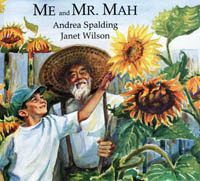
Me and Mr. Mah


Spalding, Andrea. Me and Mr. Mah. Illus. Janet Wilson. Victoria, BC: Orca Book Publishers, 1999.

Following his parents separation, Ian leaves farm life behind and moves into the city with his mother. Their new moonscape of a yard doesn't look anything like the farm, and Ian misses his father intensely. But on the other side of the fence is a lush green world of sunflowers and Chinese vegetables tended by Mr. Mah. Through a common love of gardening, the two neighbours become friends and exchange stories about farming days in rice paddies and prairie fields. Each has a precious box of memories from a time and place now gone, but the two friends also create new memories together as they explore the city (which, from the images of Chinatown and the Chinese cemetery by the ocean, appears to be Victoria, BC). The watercolour paintings are lush and appear saturated with sunlight. On most pages one full-page illustration bleeds over into a smaller painting on the facing page, leaving plenty of white space for the text. In one spread, however, the two figures sit in the centre foreground while one side shows a remembered scene from a rice paddy and the other a prairie field. The gutter is the divide between scenes, but the rich ochre colour scheme ties the two fields together and underscores the connection between the two characters in relation to their former lives and losses. A beautiful and touching story about loss, change, loneliness, and friendship across both age and culture.