Showing posts with label Information books. Show all posts

November 4, 2007

Celebrating a banned book...

Harris, Robie. It’s So Amazing. Illus. Michael Emberely. Cambridge, Mass.: Candlewick Press, 1999.

One of the sex education books in Robie Harris's popular and frequently challenged collection, It's So Amazing provides in-depth kid-oriented information about sex, sexuality, birth, bodies, babies, HIV, and related topics for children 5-9. Perfect for parents and kids to read together.

Though the language is accessible, the book is more of an information resource than a quick picture book to be read aloud at a single sitting. Those with younger children may want to start with the more basic picture book by the same author, It's not the Stork. (For older kids, Harris also has It's Perfectly Normal, a book about puberty and changing bodies in the tradition of What's Happening To Me.)

Micheal Emberley's cartoon illustrations are fun, well-researched, frank, and appealing in their ability to be both anatomically precise and humorous at the same time. Our exploration of the facts of life is guided by Bird and Bee, who hover over the illustrations with their light-hearted banter, by turns explaining new terms and providing comic relief. Right from the front cover, their vastly different takes on the subject are clear: Curious Bird wants to know it all, "Every single thing about there babies come from is SO-OOO A-MAZING to me!", while embarrassed Bee is a slightly less enthusiastic, "Can we talk about something else? ANYTHING else?"

Since its publication in 1999, this book has been challenged and banned based on sexual content matter, nudity, and references to abortion, masturbation, and homosexuality. Despite critical success, including recognition as ALA notable book for Middle Readers in 2000, the book continues to be challenged.

Frankly, if a sex education book for children is challenged on the basis of nudity and sexual content, and for even mentioning topics like homosexuality or abortion, I am a little concerned about the content of sex education books that are not challenged. And it is heart-breakingly clear in this particular case that moving such a title to an adult or reference only section is a form of banning the book, since it is clearly aimed at children and will generally only be useful to adults in relation to children.

For a brief history of some of the situations in which the title was banned (access was denied or restricted) or challenged (a request was made to remove the book from a collection or restrict access), check out these links:

Marshall University Library's Banned Book Week webpage


Why Have These Books Been Banned/Challenged? (ALA)

February 17, 2007

The Wonder in Water


Swanson, Diane. The Wonder in Water. Toronto: Annick Press, 2005.

This book focuses on water in many of its different forms, providing some basic facts about the important role it plays both in human life and in the surrounding environment, and then exploring some of the more extraordinary facts and phenomena related to water. Because the subject is broken into discrete topics (like sweat, puddles, rain, and marshes) the book doesn’t do a great job of talking about the water cycle itself although the connections are mentioned in passing within the text of each section. These mini-chapters also don’t always focus on the topic named: The “sweat” section, for instance, acts more as an introduction with general facts about the importance of water to human survival and the amount of water in the polar ice caps. The strength of the book is in the outrageous and fascinating facts described, such as the turtle that once fell inside a giant hail ball or the phenomenon of rain-delivered slime mold that can move across fields or up telephone poles. The photographs are appealing and informative, the design is attractive and contemporary looking, the tone of the text is conversational and accessible, but the overall organization doesn't appear conducive to an overall understanding of the topic. Where this book shines is its ability to invoke wonder at the natural world. There are no sources for the information which, considering the extraordinary nature of the facts, is a little disapointing but probably not uncommon for books aimed at such a young audience.

** out of 4

Looking at other reviews:

Hazel Rochman's review
(Booklist via Amazon.com) seems more positive than mine, but does also focus on the extraordinary facts as the main strength of the book. She also highlights the "chatty" tone of the narrative as a positive feature, especially for read-alouds, whereas I found the tone conversational but a little condescending or overdone in places.

Elaine Fuhr's review for CM was even more positive (giving the book 3 1/2 stars out of four), but she focuses on the same sense of wonder and the "wow" factor produced by this extraordinary collection of facts.

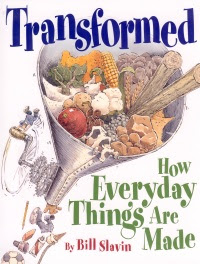
Transformed: How everyday things are made


Slavin, Bill. Transformed: How everyday things are made. Toronto, ON: Kids Can Press, 2005

Award-winning picture-book illustrator Bill Slavin has brought his considerable talents to bear on a well-chosen and engaging topic – the hidden manufacturing process by which familiar objects are created. This over-sized book has everything that makes the new generation of information books for kids both popular and successful: The subject matter is both easy to relate to and fascinating; the pages are well-designed and appealing, the information is broken into small easy-to-read chunks that are clearly arranged, and the illustrations are both informative and humorous. The everyday objects are divided into categories, and each is presented on a separate two-page spread with consistent design elements. The page begins in the top left hand corner with a title and a brief but enthusiastic introduction to the object at hand that doesn’t focus on the manufacturing process but rather provides an amusing and engaging anecdote (often historical) to introduce the reader to the object itself. The page is dominated by an illustration of the stages of production, each of which is described by one or two sentences. These small blocks of text are spread out over the pages but numbered to suggest a clear sequence of reading, which is helpful considering they are not in any obvious visual order. There are also fun facts in sidebars, but not so many as to overwhelm the visual balance of the page or push the reader into information overload. Especially pleasing is the white background of the pages that allows the illustrations to shine, while paring down on the visual clutter that can make information books difficult to read. Slavin’s cartoon-like watercolour illustrations, which feature comically miniature people working on larger than life objects, bring a whimsical sense of humour to the project while managing to effortlessly convey a great deal of technical information (including cross-sections and magnifications). The information is supported by a table of contents, glossary, index and some suggestions for further study, as well as some notes on who helped research the information (but no actual sources). Part of the joy of this book is that the objects themselves are things that will be familiar to most readers, like baseballs or CDs or breakfast cereal, but the information about how they are made is likely to be new to children and adults alike. The information is clear and succinct, but not dumbed-down. The writing and illustrations both convey a sense of wonder and fascination, and will help foster an ongoing interest about the science of everyday objects that will extend far past the pages of the book. In the ever-increasingly popular world of information books for children, this is as good as it gets.

****/4

Looking at other reviews:

Gail Hamilton's review in CM also gives the book a similarily positive review, and focuses on some of the same aspects of the book such of the finessing of the balance between too much and too little information, the effective use of humour in the illustrations, and the additional resources. She uses several examples from the book which I liked since it gave me a better sense of the actual content of the book.

GraceAnne DeCandido's review
(Booklist via Amazon.com) is also generally positive but points out some small historical inaccuracies I would not have been able to catch without fact-checking.

Hemp Jewellery

Sadler, Judy Ann. Hemp Jewellery. Illus. June Bradford. Toronto, ON: Kids Can Press, 2005. [From the Kids Can Do It series].

After a brief introduction to the materials and core techniques, this basic and somewhat formulaic how-to book presents several individual projects that can be made using hemp twine and beads. Each project begins with a list of required materials and a photo of a kid modelling the finished project, and then provides step-by-step instructions. Each of the steps are numbered, the instructions are effective and succinct, and the ink-and-watercolour illustrations of each individual step make it easy to follow along. The text and visual components work well together in a functional sense – they allow the reader to learn the techniques and construct the featured projects – but there is little inspiration to be found in this book either in enthusiasm for the topic or in the visual appeal. The cover, with photos on a mauve and turquoise background decorated with geometric patterns, manages to look both overly juvenile and outdated (circa early 1990s?). And the subject matter itself seems dated as well - are kids still making hemp jewellery, or did this fad mostly die about ten years ago? If someone wants to make hemp necklaces or bracelets, this book is a useful and functional resource that will give them the basic information they need to get started. The book will do little, however, to introduce readers to a new subject or inspire them to learn a new skill.

* out of 4 (or ** being generous)

Looking at other reviews: Other people seemd to review this particular book much more positively than I did. I did notice, however, that many reviewers spent most of their space describing the book and very little actually evaluating it.

Carolyn Phelan (Booklist review via Amazon.com) and I agree about how easy the instructions are to follow, but we seem to have different ideas about what makes a book "attractive." (Although I do admit that my issues are mostly with the cover - the step-by-step illustrations are clear and attractive in the tradition of knot-tying instructional guides, which is an aesthetic I happen to enjoy). She also notes the lack of discussion about the social implications and views of the material itself, which I hadn't noticed.

Grace Sheppard's review in CM
is positive for the most part, but ends on this intersting note: "Despite the possibility of macramé flashback for some readers, this book will be heavily used by crafters at school and public libraries." Who is she thinking will be having the macrame flashbacks? The elementary school kids? I think flashback is the operative word here, but for me this meant an trip back to early university days when hemp jewellery was all the rage in the twenty-something crowd at festivals and markets. I may be dangerously out of touch with the elementary crowd, but I really don't think this particular craft has the currency and appeal of, say, a how-to book about drawing manga.