Showing posts with label LIBR521-week 1. Show all posts

January 16, 2007

Madlenka's Dog


* Sis, Peter. Madlenka's Dog. Vancouver: Douglas and McIntyre, 2002.

When Madlenka takes her dog for a walk, the reader can't see the dog that pulls the leash and collar in front of her but everyone else she meets in the neighbourhood can, and they each see the dog differently. Peter Sis uses simple lift-the-flap additions in his illustrations to show each person's memory of themselves and a dog from their past, highlighting the switch in mode with different colour schemes against a predominately black-and-white page. Much of the complexity of the narrative resides in the illustrations themselves that offer the reader entry into the memory or imagination of each different character. Other than the central two characters, Madlenka and her friend Cleopatra, these representations of imagination or memory are the only aspects of the illustrations shown in colour. Early pages have only touches of colour, while the sequence of two-page spreads which dive into the two girls' imaginative play are dominated by colour scenes with black-and-white images of buildings on either side receding with each page turn, then re-appearing as Medlenka is called home. Text and image are inextricably linked throughout, with the simple text extended by a complexity of visual cues not often seen in picture books for young children.

Imagine a Night


Thomson, Sarah. Imagine A Night. Illus. Gonsalves, Rob. Toronto: Antheum Books for Young Readers, 2003.

This book presents an interesting relationship between image and text, one where the paintings clearly came first and the text was written as an effort to create an overarching narrative framework (if not exactly a story) in which this series of images becomes a picture book. Rob Gonsalves paintings take visual cues from the the surrealists and the mathematical trompe l'oeil work of Escher, to create unearthly images of night in which ordinary and often somewhat domestic scenes transform at one edge into wild living landscapes: quilted bedspreads become the pattern of farmer's fields as seem from a plane far above; deep drifts of snow become rectangles of white bedding ready for sleepers. In the world of picture books, this book is visually reminiscent of the work of Anthony Browne, although the narrative is much less complex. The narrative isn't really a story at all, but more of a companion to the paintings which are the dominant focus of the book. Kids, especially older ones, with an eye for detail and a keen sense of imagination may enjoy the paintings and lyrical language, but those who read for plot, humor or character may be less engaged.

January 15, 2007

Gorilla! Gorilla!


Willis, Jeanne. Gorilla! Gorilla! Illus. Tony Ross. New York: Atheneum Books for Young Readers, 2005.

When mother mouse's baby goes missing, she searches all over the forest but she can't find him. Just when she thinks things can't get any worse, she is chased by a gorilla who keeps hollering for her to stop. She runs all over the globe, but she can't seem to escape the very determined gorilla. The pastel illustrations are colourful and energetic, relying heavily on contrast in size and colour to emphasize the difference between the two animals, to build the tension (especially at the height of the action when the gorilla comes closer and closer until the bright red of his open mouth practically glows against the constrast of his dark face), and to convey tenderness in the end. The illustrations also highlight the sense of travel and distance by using different styles and colour schemes for each of the different locations pictured.

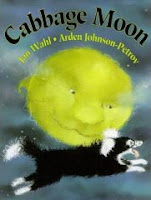
Cabbage Moon


Wahl, Jan. Cabbage Moon. Illus. Arden Johnson-Petroy. Honesdale, Pennsylvania: Boyds Mills Press, Inc., 1998.

Princess Adelgitha and her dog Jennie love the old cabbage moon. So when Lorenzo Squink steals the moon and starts making cabbage salad, the two must figure out a way to come to the rescue. The text has occasional moments of awkwardness, and the ending (avec prince and marriage) seems a little tacked-on , but other than that the story is enchanting, especially because of the illustrations. The bright pastel images are full of texture and energy, and provide an excellent match for the quirky imaginative mood of the text. The images essentially re-tell the same story as the text, but they add a more developped sense of character - to people, the dog, and even the moon.

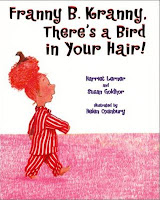
Franny B. Kranny, There's a Bird in Your Hair


Lerner, Harriet and Susan Goldhor. Franny B. Kranny, There's a Bird in Your Hair. Illus. Helen Oxenbury. Harper Collins Publishers, 2001.

Franny's wild frizzy hair gets her into a lot of trouble - with her mom and kids on the bus and even the refrigerator door - but Franny loves her hair and refuses to cut it for the family reunion. When a bird makes its home in her new hairstyle, Franny is the star of the party. The detail in Helen Oxenbury's colourful cartoon-like drawings brings the humor and emotion of the story to life. The illustrations are expressive and communicative enough to stand on their own as a narrative, but the text is playful well-written and this picture book is a pleasing example of how text and image together can be more than the sum of their parts.

Go Away Big Green Monster


* Emberly, Ed. Go Away Big Green Monster. New York: Little, Brown and Company, 1992.

"Big green monster has two big yellow eyes, a long bluish-greenish nose..." So begins the incantation that brings the big green monster to life, page by page, in tandem with cumulative single-colour die-cut pages. As the story begins, the cut-away portions of each black pages reveal a larger part of the monster's face until the image culminates in a full monster face. Then the narrator tells the monster to go away, and a part of the monster face disappears from the layers of the portrait with each page turn. This simple story relies on a shifting relationship between text and image: At first the text is reactive, describing each new image as it appears; then, in the second half, the text makes a demand and the action of turning the page responds to that demand by making the corresponding part of the monster disappear.

A beautifully created book, and the invitation to participate makes for a satisfying read-aloud or bedtime ritual.

January 14, 2007

Kitten's First Full Moon

* Henkes, Kevin. Kitten's First Full Moon. Greenwillow Books, 2004.

"It was Kitten's first full moon. When she saw it, she thought, There's a little bowl of milk in the sky. And she wanted it."

Though illustrated with gouache and coloured pencil, Henke's use of an almost entirely black-and-white pallette, the strong sense of line, and the subject matter remind me of Millions of Cats. But the story here is much sweeter and more whimsical: Kitten keeps trying to get at the bowl of milk in the sky, and various misadventures follow until she returns home wet, tired, hungry and disappointed - only to find her own little bowl of milk waiting for her on the porch where she began.

How do the pictures tell the story?

The text and illustrations work together well to tell this simple story. Although the illustrations don't extend the story beyond the textual narrative, they do visually clarify ideas in the text and add to the expressiveness of the story. The layout of the illustrations shifts between full page spreads, series of comic-like frames, and individual elements isolated on an white background. The pages which feature the cat in one corner and the moon in the other on an otherwise blank page provide structure for the narrative, working with the text to create repeating elements that highlight the patterened language and help reinforce the concept that the "bowl of milk" Kitten sees is actually the moon (when this is not mentioned in the text). The overall effect is enchanting, humorous and exceedingly likeable. A great read-aloud.

A Caldecott Medal Book.

Yo! Yes?

* Raschka, Chris. Yo! Yes? New York: Orchard Books, 1993.

This is the enchantingly simple story of a conversation that becomes a friendship.

How do the pictures tell the story?

It is impressive to see how language that is simple, entirely monosyllabic, and limited to one or two words a page can be so expressive and finely crafted. Likewise, the illustrations feature nothing more than the same two kids on each spread, yet manage to create an engaging narrative interaction based only on variations in expression and posture. The watercolour and charcoal illustrations are strong, playful, emotionally expressive and inseperable from the text, and even the text becomes part of the overall visual effect.

A Caldecott Honor book.

Learning the language of picture books


Horning, Kathleen, T. "Picture Books." In
From Cover to Cover: Evaluating and Reveiwing Children's Books. New York: Harper Collins Publishers, 1997.

For anyone wishing to write about picture books, Kathleen Horning's chapter on this subject provides an excellent basic introduction to the elements of picture book text and illustrations, the relationship between the two, and the vocabulary used to descibe the different aspects of each one. For text, she discusses the importance of structure, patterned language, predictability and pacing, using excerpts from well-known picture books to demonstrate the successful use of each. On the topic of illustrations, she covers visual elements, composition, media and style. She provides titles and descriptions of picture books that exemplify these different aspects of illustration, but the reader will need to go to the books themselves for visuals since the book itself has no images. She also provides an sample discussion of Margaret Wise Brown's Goodnight Moon as a way of demonstrating how this vocabulary can be used to investigate the success with which specific elements of text and illustration in a picture book work together to create an intentional overall effect.

Horning, Kathleen, T. "Writing A Review." In From Cover to Cover: Evaluating and Reveiwing Children's Books. New York: Harper Collins Publishers, 1997.

In her final chapter, Horning introduces the novice children's literature reivewer to the history, importance and major sources of literature reviews, focusing on the various strategies and ingredients that make for readable and useful reviews. She provides practical how-to advice, which is supported by numerous excerpts from the work of established reviewers. Her discussion of the balance between the descriptive, analytical and sociological elements of a review is especially useful.

January 13, 2007

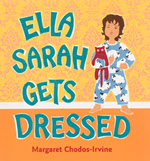
Ella Sarah Gets Dressed


* Chodos-Irvine, Margaret.
Ella Sarah Gets Dressed. New York: Hourcourt, Inc., 2003.

This fun, playful and beautifully illustrated book tells the story of Ella Sarah who knows exactly what she wants to wear, even if her family doesn't agree with her fashion choices. The printmaking techniques that leave narrow white gaps between blocks of colour, combined with the bold but slightly muted colours, create an effect reminiscent of early colour offset printing. The images rely on colour, shape and texture rather than line, and convey a great sense of emotion and exuberance.

How do the pictures tell the story?


The pictures very much the same story as the text, but in a different order. The text begins with the outfit itself - the pink polka-dot pants, dress with orange and green flowers, striped socks, yellow shoes and red hat - and repeats it as a chorus as the reader is lead through the alternate suggestions from family members, the disappointment, the strong-willed refusal, and finally the triumph and celebration of individuality. A reading of only the images tells the story in reverse, with the interactions first and the outfit itself as a punch-line or reveal near the end. When read out loud, the subtle difference between these ways of telling the story creates tension and a subtle kind of visual suspense that makes the joyousness of the closing images even more enjoyable. In the last few pages the text gets shorter and shorter while the illustrations become increasingly energetic and expressive, until there is no text at all and the pictures tell the entire story.

A Caldecott Honor Book.

The Red Book

* Lehman, Barbara. The Red Book. New York: Houghton Mifflin Books, 2004.

In this wordless picture book, a girl in the city finds a red book and opens it to find a map of a faraway island which magnifies in scale, frame by frame, to reveal a boy walking on the beach. He finds his own red book which in turn opens to a detailed city image which magnifies until he sees through a window to a girl a reading a red book with a picture of a boy on an island looking back out at her. The story takes the age-old device of the magic book (or object) which pulls the character-reader into a magical reality but, since this is a wordless story, the text is replaced by maps with their own particular visual language. It is hard not to be transported by this gentle and whimsical story about friendship, happenchance, magic, and the wonder of maps.

I was in love with this book from the moment I laid eyes on its invitingly, indulgently, perfectly red cover. In fact, having chosen the book by cover alone, I parked at the beach on my way home from the library because I couldn't wait to read it. And the story inside didn't disappoint: the beautiful, bold and deceptively simply illustrations in watercolour, gouache and ink create a complex and nuanced narrative. Each time I re-read it, there were new layers to discover. This story has that elusive quality of wonder that makes me see the world differently; when I closed the book and walked along the beach, I really did expect a strange new friend to appear in the sky suspended from a large bunch of balloons. I loved that simply by carrying the red-coloured book, I became an echo of the story inside it and the world around me seemed that much more magical for it.

The Red Book has enough story to convey a clear narrative, but enough mystery to create intrigue and scaffold imaginative discussion. This is a perfect book for one-on-one dialogic reading. It is impossible not to compare this book to Davide Wiesner's Flotsam, another consummate wordless picture book featuring a camera which washes up on a beach and creates a connection between children across great distances and through time.

Wordless picture books are a fantastic genre that seems to be gaining popularity. They have a wonderful versatility - they can be told in any language, they can be used by parents with low-literacy, they can allow children to take on the role of telling the story to an adult (or each other) before they can read, and they provide a great vehicle for children to practice their own narrative and linguistic skills. They also situate the language pre-literate children use to read picture books - the language of images - in a primary role, empowering children to be direct readers with or without adult participation.

It took several readings for me even notice that the book's title was a visual one: No where on the cover (except the spine) does the text "The Red Book" appear, but with an entirely red cover broken only by the small image in the corner of a girl running with a red book in her arm, the book is unmistakably identified as The Red Book.

A Caldecott Honor Book, and no surprise.