November 13, 2011

I want my hat back

This is perhaps the best picture book I've seen all year. And I don't say that lightly - a LOT of picture books come across my desk. But occasionally there's a gem that reminds me why I love children's literature so much.

The plot is deceptively simple - Bear is looking for his little red pointy hat and talks to many animals in his search - but the text is masterful, pitch-perfect, and laugh out loud funny. This last claim has been laboratory tested, at least on adults: I walked around the office and made my coworkers read the book and watched them all pause for a couple of seconds at the end and then gasp and laugh.

Have I not mentioned the illustrations yet? I would frame this whole book and put it on my wall. The illustrations are simple, nuanced, funny, mostly understated and absolutely stunning. And even the book design is an integral part of the pleasure of this picture book - the text design (font, size and colour) interacts subtly with the storyline in a pleasing way, the pages are beautifully laid out, and the colour scheme is restrained in a way that makes colour use sing with meaning. What's amazing to me, though, is that this is the first picture book where Klassen has moved from being an illustrator (of great talent) to an author-illustrator. This is not an easy transition, and I've seen it go poorly more often than not. So colour me surprised and impressed - there are only a handful of truly great author-illustrators alive today, and I think this book makes Jon Klassen a force to watch out for.

If you have an older preschooler in your life (a mature 3 year old, a 4 - 5, or even 6 year old?) who enjoys animals, great illustrations, and doesn't mind a bit of morbid humour, this is the perfect present. Even though the text is very simple, I suggest it for preschoolers instead of toddlers because the humorous finale does take a bit inferring power to understand. Spoiler - if you are morally against a bit of implied animal-on-animal violence, this is not the book for you.

Oh, and did I mention that Jon Klassen is Canadian? This one's going to win some awards. It's almost not fair that Klassen's recent picture book illustrations for Cat's Night Out won the GG in 2010. If I was on the committee, I'd find it hard not to to give that award to him again.

June 26, 2011

The Red Tree

Tan, Shaun. The Red Tree. Vancouver, BC: Simply Read Books.

Thought about this book again recently when buying a present for a friend of mine who was graduating from her program in counseling psychology.

I don't say this often but I'll say it now: This man is a genius. I couldn't have been happier when I found out earlier this year that he'd won the Astrid Lindgren Prize (see the article in the Guardian), which is one of the only children's lit award accompanied by truckloads of money. Couldn't have gone to a better person.

The Red Tree is a heart-stopping picture book that deals with depression or difficult times in an accessible, deeply moving, and entirely un-condescending way. It also offers an equally real, visceral, almost experiential vision of what hope can be. And since the arc of the book so firmly rooted in its images, the red tree with its rich and sudden appearance of colour at the end is a mysterious and unexpected gift. And although it seems to appear out of nowhere, a closer look will reveal a small red leaf on every page of the story, even at its bleakest moments.

I love the way illustration and text combine seamlessly to create a otherworldly, dreamlike (and at times almost sinister) vision, and the way the book veers away from intellectual understanding and avoids being prescriptive or didactic. The text is sparse and deceptively simple. The illustrations are rich, sombre, complex, detailed, expressive and textured. The emotional content of the book is palpable and unrelenting, in a way I don't think I have ever quite experienced in a picture book. Some people seem to think this makes it unsuitable for children (it's been challenged in my library), but I can't help thinking it actually mirrors the very profound and all-encompassing way children often experience emotion. It certainly isn't a preschool storytime read-aloud, but it has that amazing quality that will make is riveting to a wide range of ages, from young school age children to adults. Quite simply, this is one of the most stunning picture books I've ever seen, from one of our most talented illustrators (and writers).

One small quibble: I couldn't help taking issue with the line "the world is a deaf machine," for obvious reasons. It's the only thing I don't like about this book. It's too bad he chose that particular metaphor, because it does make me hesitate to cheer as loud as I can for what is otherwise nothing short of masterful, but the book is too amazing for me to pass it up for this reason.

An older one, but a good one. One of my favourites. The kind of book that genuinely moved me in that powerful somewhat pre-verbal way; the kind of book that might make a difference in someone's day or life. See what Shaun Tan has to say about the book. And while you're there, check out the rest of his website. You won't be disappointed.

June 24, 2011

Patrick Ness wins the Carnegie

Fresh from The Guardian's section on childeren's books: Patrick Ness accepts Carnegie medal with fierce defence of libraries. He wins for Monsters of Men (Walker Books, 2010), the third in his dystopian Chaos Walking series, all of which have been nominated for the Carnegie. No small feat.

I love everything about the title of this article. Oh, except the part about the libraries in the UK getting their funding slashed. Yeah. I hate that part. I'm all for the amazing work that volunteers do in the world. But that's not a replacement for paying an entire country full of public librarians. Don't even get me started.

I wish there didn't have to be a rash of amazing authors defending libraries. I wish I didn't have to find out what a sucker I am for a charming defense of my profession - really, it's like my version of watching cute talking dog videos - but I sure do appreciate.

Press Here!


In France, Herve Tullet is know as the King of Preschool. Press Here (Chronicle Books, 2011) is his latest picture book - and what a hoot! At first the series of coloured circles and written instructions (press the yellow dot, shake the book, clap twice, etc.), might not seem like much, but add kids to the mix and watch the magic happen. I could keep describing, but wouldn't you rather watch kids play? CLICK HERE for the video trailer!

And see Herve Tullet in action here - great stuff: "There will be three people. I will be in the middle in my book. And there will be a child. And there will be someone who knows how to read the book. And I hope everybody could play with the book. The child could play, and the adult could play too."

June 23, 2011

Book reviews for the Early Childhood Educator

My latest book review column is out in the Early Childhood Educator journal. Unfortunately current content for the journal isn't available online, but you now see older articles including one of my earlier book review columns called: Let Children Take the Lead with Wordless Books.

This month's theme is Aboriginal childcare, and my column features some of my favorite Aboriginal pictures books including:


Zoe and the Fawn, written by Catherine Jameson (Shuswap/Okanagan/Syilx), illustrated by Julie Flett (Métis)


The Little Hummingbird by Michael Nicoll Yahgulanaas (Haida)


Lii Yiiboo Nayaapiwak Lii Swer: L'alfabet Di Michif = Owls See Clearly at Night : a Michif Alphabet
. by Julie Flett (Métis)


Learn the Colours with Northwest Coast Native Art (and other titles in the board book series), created by Native Northwest Educational Resources


Shi-shi-etko by Nicola I. Campbell (Interior Salish/Métis), Illustrated by Kim LaFave


I also talk about the BC Aboriginal Child Care Society and some of their excellent lending resources. If you're in British Columbia, check them out. They have lots of valuable resources developed for Aboriginal child care centers, including ECE curriculum boxes which can be borrowed for use in circle time or other activities. Their "Moe the Mouse" speech and language development program is a fabulous resource developed by two speech-language pathologists for the BC Aboriginal Child Care Society. Rather than singling out children who have difficulty making certain speech sounds, and focusing on repetitive “corrective” or “teaching” exercises, this program uses an appealing mouse character to present fun speech and language activities to an entire circle time group, with a focus on aboriginal content. Children who need extra help get a fun supportive low-pressure atmosphere to practice their sounds, and everyone has lots of fun. We recently had the training at our library, and my colleagues who use this in their outreach programming report that the kids love Moe!

Check out the journal article for more information on these books and resources.

January 16, 2011

Technology, ethics, and some damn good reads

A friend asked me recently to suggest a book for a high school class - something off the beaten curriculum, something with teeth-sink-into-able issues, something with the appeal of The Hunger Games that hadn't been read out yet and, most importantly, something NOT ANCIENT (but maybe available in paperback).

Immediately, my mind jumped to Little Brother. I really do not understand why this book is not as big as The Hunger Games. Cory Doctorow has a cult-like following in the adult world, and the book did indeed make it to the NYT bestseller list, but somehow it doesn't fly off the shelf at the library at the rate we expected.

It's one of the best teen books I've read in ages, a story that only gets more relevant as our governments use the terrrorism scare to erode civil liberties. This cautionary dystopia is made even more chilling by the fact that it seems to be set about three weeks in the future. Didactic? Yes, without question. But so relevant, precisely-aimed and well-crafted that it remains a work a literature. And a profoundly readable one at that.

After a terrorist attack on the Bay Area transit system, 17 year old Marcus Yallow and his friends are picked up and questioned by the Department of Homeland Security based on suspicious activity like being in the area, demanding help for an injured friend, and refusing to give up the password on an encrypted phone. When Marcus defends his right to his own privacy, he is detained and tortured in what is later referred to as "Guantanamo by the sea." When the friends are finally released, the Department of Homeland Security has turned San Francisco into a police state.

From high-tech gait-recognition cameras to the hacking of the xBox, technology plays both sides in this struggle for freedom and privacy in a world of surveillance. Plenty to talk about here. The e-book is available for free download on the author's website. A great modern-day companion to 1984.

Another great technology-meets-ethics book is The Adoration of Jenna Fox by Mary Pearson (Henry Holt, 2008). In a more distant future, Jenna (also 17) awakes after a terrible accident with absolutely no memory of her previous life. She tries to reconstruct her previous existence, but things don't seem to add up. Her parents, if they really are her parents, are hiding things from her. She struggles to escape her parents' over-protective confines and discover who, or what, she is. A story about the limits of technology, and the limits of humanity. A fabulous read with ample sparks for conversation and debate.

September 11, 2010

Mockingjay


When I got a concussion last year, I was advised not to try to read for a while. The problem was, I was 50 pages from the end of Suzanne Collins' Hunger Games. Seriously, folks, just try not finishing that one. So I'd read for 10 minutes (my max) and then lie in the dark for half an hour waiting for my brain to recover and then read again for ten minutes. And if I read for more than 10 minutes I'd suddenly start shaking uncontrollably. Then I'd lie in the dark for another 30 minutes and start all over again. But I just couldn't stop. That's got to say a lot for a book.

In the middle of my recovery, I listened to Catching Fire (the second installment) on audiobook. And much as I like audiobooks (and couldn't have lived through the last year without them), it just wasn't the same as tearing through the book at light speed and getting lost in another world. It wasn't a bad production, but I can't say it was memorable either. I've heard better in the last year. There are books I'd suggest listening to over reading - this wasn't one of them.

So it is my pleasure to report that the first book I have officially devoured in only a couple of sittings is Mockingjay. And what a pleasure it was. I'd almost forgotten what it felt like to sit down with a half-finished novel the day stretching ahead of me and know I was going to read the damn thing till I was done. There's really no point adding one more review to the pot, except to note my delicious relief as a children's librarian that the current 'it' book is actually both-well written and interesting. The hot teen books are always eminently readable, but I often shut off a portion of my brain to enjoy them. I'll admit I was a little traumatized by parts of the grimness and violence - I'm not good at reading about the particulars of war. But it's a fabulous smart series, and deserving of all the attention it's getting. What a perfect book to satisfy the current market hunger for teen/adult cross-over novels. If for some reason you haven't read it, and can handle a good dose of dystopia with your Saturday morning tea, this is the next series you want to get your hands on.

It's a beautiful circle for me to round out the concussion on both ends with such a different experience of this same trilogy. Reading: I've missed you!

November 8, 2009

Just when you need some rocket-powered unicorns to make it through the day...


An Awesome Book by Dallas Clayton

And it really is! This self-published gem came to my attention last year at the BCLA conference, courtesy of a fellow children's librarian. The story is all about dreaming big, and it's perfectly lovely, but the illustrations are what blow the roof off my popsicle stand.

The spread of pink rocket-powered unicorns (variously wearing basketball jerseys, scuba gear, or riding mini-skateboards) is worth the price of admission alone:


You can see the entire book online here, but this is a book worth holding in your hands. I think it could have ended about half way through (the rhyming verse gets a little long-winded and didactic near the end), but it still steals my heart every time I lay eyes on it. Check this one out for sure. And if you just want to look at rocket-powered unicorns all day, you can even buy the poster here. And while you're shopping, check out the cause that your purchases support. Very cool all around.

October 25, 2009

Another great audiobook


Ender's Game by Orson Scott Card, read by Stefan Rudnicki and a full cast

Not surprisingly, when I look up the reviews for the next great audiobook I listened to, it's also an AudioFile Earphones award winner. Check out the review here, and listen to a short clip.

Ender's game is the story of Andrew ("Ender") Wiggins, a child genius who is recruited by the military at age five to fight in the ultimate war again the aliens. We follow his experiences at an off-planet school for child soldiers, where he is ostracized early by his combination of skill, young age, and the manipulation of the military handlers who hope to create a new breed of commander. Ender excels in the zero-gravity "battle room" training exercises, but must struggle to understand his place in this strange and often brutal military world populated almost entirely by other children. Before Ender reaches adolescence, he will have the opportunity to the course of history forever.

This is one of the absolutely classic science fiction titles. When I've talk about science fiction with friends, this is the number one title that jumps out of my their mouths. Perhaps because I wasn't a big SF fan when I was younger, I seem to be the only person I know who didn't read this book as a teenager, or even a kid. For some reason it's in the adult section at our library, which I think is unfortunate since it's one of those great, smart stories which presents challenging ideas from a child's point of view. Sure this story is substantial enough to appeal to adults, but so are many kids' novels. The story is read by a full cast of actors, and the narration is both compelling and easy to listen to. I got lost in this story for days, and was sad (in that particular nerdy book-loving 12 year old way) when it finished. A great story to go back and find if you missed it! And a great SF book for all of you who think you're not really the SF type.

hooray for audiobooks!

Okay, so I've recently been recovering from a concussion. I don't suggest it, really. Especially if you're also daylighting as a librarian. But while I've been unable to read any books over about 15 pages recently, I've been listening to audiobooks. Thank you universe for audiobooks. Without which I might seriously have lost it.

I'll try to share a few of my favourites. To begin:

The Absolutely True Diary of a Part-Time Indian, written and read by Sherman Alexie

Not only is Sherman Alexie a talented writer, and funny as fuck, he's also a fantastic speaker and storyteller. You've probably heard of this book already - it's (fairly) received a lot of great press. But this is also one of those rare treats where we get to hear the original author read their own work, with the knowledge that no one else could possibly have done a better job. The book follows the adventures of fourteen year-old Arnold Spirit (AKA "Junior") as he decides to head out beyond the world of the rez and attend high school in the nearby (and overwhelming white) small town farming community, while still living at home on the reservation. Alexie doesn't shy away from the difficult, and this story has more than its fair share of death and heart-wrench, but it also has its own brand of smart, cutting, dorky, honest and deeply perceptive humour. And by humour I mean don't risk drinking milk while you listen to this story. I know the original has comics included, but somehow this version didn't leave me feeling like I'd missed anything. A truly consummate audiobook.

Check out Sherman Alexie's website under "Audio" for an mp3 clip from the audiobook, and for a list of the stupid number of awards and prizes this book/audiobook has received. Of particular note for the audio version is the Earphones award from AudioFile. AudioFile is a fantastic review source just for audiobooks - check out the AudioFile review here (and click on "listen" for an excerpt.)

February 14, 2009

A Kick in the Head


Janeczko, Paul. A Kick in the Head: An Everyday Guide to Poetic Forms. Illus. by Chris Raschka. Cambridge, MA: Candlewick, 2005.

I just got a new job and a lovely co-worker just surprised me with this beautiful book as a going away (though not very far – I’ll just be at a different branch) kind of present. Wow. It’s simply stunning. The book covers 29 different forms of poetry, with examples and brief explanations. But the clean spare presentation speaks more to a showcase than a textbook. Each poem is given its own page, with a brief note at the bottom indicating the name and basic structure of the form. Further explanations (about a paragraph each) can be found for each form in a section at the end of the book. And the illustrations (a combination of paint and collage) are both stunning and appropriate, with plenty of white space to give the design a sophisticated feel. This is no surprise, given Chris Raschka’s previous success with children’s book such as YO! YES? and Charlie Parker Played Be Bop. But even the smallest details, like the small blue painted icons created to represent each form, are brilliant: Perfect whimsical little symbols that somehow perfectly echo something essential about the nature of the form (a syllable count, the number of lines, a theme), without being strictly representative.

I love poetry, and I love great children’s books. What a gorgeous present. Any teachers exploring poetry will find this book to be a powerful ally – both as a source of information and inspiration. And since the book is simple, accessible, and yet entirely devoid of condescension, it will work with a wide range of ages. I know I’ll be consulting it the next time I need to remember exactly how a pantoum works, or simply when I’m scouting for ideas.

Graceling


Cashore, Kristin. Graceling. Orlando, FL : Harcourt, 2008.

I’m assembling a mental list for my adult friends who have read all of Tamora Pierce’s teen fantasy novels, and are looking for other great books to turn when they want to spend an indulgent winter day in that comfortable chair by the window entranced by another world.

Most of these stories feature a fiercely strong female lead in a traditionally male-dominated domain, an otherworldly or magical talent that sets her apart from her peers, a great challenge of justice, and often a bit of reluctant romance to take our wildly independent protagonist by surprise (without threatening to tame her).

Recently I enjoyed Shannon Hale’s Goose Girl which, though a little more gentle than Pierce’s novels, still brings a rich a satisfying story to the table. But Graceling has a fiercer edge to it, a little more wildness. Now in her late teens, Katsa is a deadly figher, albeit a reluctant one. Since she was a child, Katsa’s eyes – one green and one blue – have marked her as gifted with a Grace, an extreme and superhuman skill. Used as a pawn by the King, she learns to despise her skill – the Grace of killing – and eventually seeks to control her own destiny and make her own decisions. When she meets Prince Po, Graced with combat skills, she discovers an uncomfortable match for her own powers and an unexpected ally. When a mission to rescue a prisoner gradually reveals a larger and much deadlier plot for power, the two must team up against a force that threatens all of the seven kingdoms.

The romance here is more prominent than in Pierce’s novels, but includes similar themes such as the struggle to reconcile vulnerability and independence. I enjoyed the underlying erotic tension of a deadly female fighter who finally meets a man skilled enough to give her a satisfying fight. And although Katsa learns to love, to trust, and to live with some measure of vulnerability, she never loses her wild and fiercely independent nature. And she doesn't seem to lose any of her personal distaste for marriage.

I occasionally wondered whether it might be too close to Pierce’s writing for some of my friends, but I thoroughly enjoyed this book. And apparently, according to the back cover blurbs, so did Tamora Pierce: "Here's a WOW of a book! Seeing half-wild Katsa learn humanity as she battles soldiers, storms, and her own obsessive nature--I HAD to know how it ended!" As a first novel, Graceling becomes even more impressive. Kristin Cashore is a writer to watch out for. My only complaint is that I have to wait for more news of this world. Well, not too long. Fire, the prequel to Graceling, is due out this fall. And a third book is apparently in the works.

Penguin and the Cupcake

Penguins and cupcakes - could there be a more charming combination?

Read my review in the latest edition of CM Magazine...

September 1, 2008

Mrs. Chicken and the Hungry Crocodile


Pay, Won-Ldy and Margaret Lippert. Mrs. Chicken and the Hungry Crocodile. Illus. by Julie Paschkis. Henry Holt and Co., 2003.

When vain Mrs. Chicken strays a little too close to the river while trying to look at her reflection, she gets snapped up by a hungry crocodile. Held captive on an island in the river, she uses her wits to convince the crocodile that they are sisters. And sisters don't eat sisters for dinner. Talking animals, great dialogue, hatching babies, trickery, sharp teeth, and a gullible predator - this book has it all. The illustrations are stunning - simple stylized images in a limited range of bold colours - and the pages are beautifully designed with plenty of white (or black) space.

I've been doing a bunch of kindergarten outreach, and this retelling of a folktale from Liberia is one of my all-time favourite read-alouds for this age group. I'm not exactly sure why, but it's one of those magic stories that slowly makes the room go quiet. There's nothing quite like a room full of rapt five-year olds to make you appreciate a book even more than you did before. The story is plenty funny, with room for fun voices and many laughs, but it doesn’t depend on obnoxious or ridiculous humour to entertain; it’s just masterful storytelling. The text is complex and has enough tension to keep 5, 6 or 7 year olds interested, but is also accessible enough to read to a family storytime group with a mix of toddlers, preschoolers, and school-age children.

Time Twister


My review for Frank Asch's Time Twister, the latest in his Journals of a Cardboard Genius series, is up at CM Magazine. A humorous, quirky, action-packed, time-travelling science fiction adventure with great read-aloud potential. Check it out...

June 2, 2008

A new review at CM


I'm still here. Really! I've just been laying low as I started an excellent new job as a children's librarian. I hope to resurface soon.

My latest review is up at CM Magazine for Colors! ¡Colores! It's a quiet but truly beautiful bilingual picture book that reads like poetry - in a good way. And that's something I don't say lightly. And the watercolor illustrations - simple, exquisite, whimsical, wow! Check it out.

Also in the latest edition of CM, one of the most unusual takes on a color concept book I've come across: The Black Book of Colors. This picture book describes colors by texture, taste, smell and sound, with both text and braille. The illustrations are rendered entirely in black with raised black lines. I'm intrigued. Can't wait to get that one in my hot little hands.

March 11, 2008

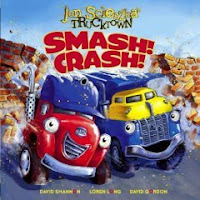
Smash! Crash!


Scieszka, Jon. Smash!Crash! Illus. by David Shannon, Loren Long and David Gordon. Simon & Schuster, 2008.

I've been stashing this book in the bottom of my storytime box with the same way one might hide a stash of tiny bills in their shoe during a serious game of monopoly. And yesterday, on an antsy rainy day, when over half of the kids brought their pet trucks to storytime, I knew its time had come. Our library has an entire section of picture books called "Things that Go" - planes, trains, race cars, garbage trucks, etc. - and the things circulate like crazy. But it's often hard to find one that will hold up as a read-aloud story. Some are pure poetry, in the tradition of Donald Crews' Freight Train, but most follow the plot of "let's go visit the fire station" or "gosh, there are some really big trucks out there." So when Smash! Crash! showed up on the new books truck, I nabbed it right away. This is the first in Jon Scieszka's Trucktown series, and it features the two best friends Jack Truck and Dump Truck Dan who like to, yes you guessed it, smash and crash. This habit tends to get them into trouble but, when Rosie the Wrecking Crane needs help, who better to call on than our two trouble-making friends?

Within seconds everyone was listening intently, and crowding onto the mats up front. Even the pet trucks were still. It's a great read-aloud with the possibility for fun voices, repeating lines, loads of action, charismatic truck characters (who presumably will each take centre stage in later installments of the series), energetic illustrations and, best of all, it's actually got a story to it. There was a minor riot to manage as kids rushed for the book after the last song, and at least one hold placed on the spot when no other truck book on the shelf would do. When I walked by the story room an hour and a half later, a handful of kids were playing a rousing (yet oddly respectful) game of "smash and crash," and the kid who had signed out the book was still carrying it possessively under one arm.

I had a little moment when it seemed like the only two obviously girl trucks were playing pirates while all the other trucks were doing real-world jobs, but the appearance of a very tough Rosie the Wrecking Crane put those reservations to rest.

This series is a book marketer's dream: content (trucks! construction! smashing!) that sells itself, a series of high-energy recurring characters (and animated truck characters at that), a children's author who is practically a household name (Jon "rhymes with Fresca" Scieszka), and a team of illustrators who are no light-weights either. In a time when children's books are not exempt from the machinations of brand recognition, this series has what it needs to succeed. But it's nice to see a series that draws on the creativity established children's writers and artists rather than using TV programs for instant branding to sell books with minimal content.

As a girl with a pickup truck of her own, I'm thinking this book will go far. Perhaps too far for my own taste, actually, with a 52-book series already planned, and TV and other media spinoffs in the unspecified future (see the Publishers Weekly article here)... So I'm planning to enjoy it now while Trucktown is a book series and not yet an empire.

March 9, 2008

Shortcomings


Tomin, Adrian. Shortcomings. London: Faber and Faber, 2007. [Published in Canada and the US by Drawn & Quarterly, 2007.]

Hey. Adult reading treat alert. And by “adult” I don’t mean that it’s too graphic or sexual for teens, but that the grad school humour probably just isn’t all that funny if you’re seventeen. It’s the first graphic novel I’ve read by Adrian Tomine, but I’ll probably look for more. His writing is great and his clean black-and-white illustrations are impressive – both in their technical ability and their able to convey a wide but subtly nuanced emotional range.

Shortcomings is the story of Ben Tanaka, a neurotic 30 year old theatre manager secretly obsessed with white girls. It seems, however, that Ben's secret isn't much of a secret to the people around him, especially not to his more politically-minded girlfriend Miko who organizes the Asian-American film festival in town. And Ben’s best friend Alice - tough, mouthy, plans to sleep with all the young women in her department by the time she finishes her PhD - seems to find it endlessly amusing. But when currents of identity collide, nothing is as simple as it seems. While Alice might be tough and tirelessly promiscuous, she also drags Ben along to a wedding as her pretend boyfriend in an attempt to placate her Korean parents. When Ben’s girlfriend leaves Berkeley for a mysterious internship in at the Asian American Independent Film Institute in New York, Ben has a chance to wallow, obsess, and let his neuroses flourish. But he also has a chance to do a little exploring of his own.

The content is interesting both in its examination of the intersections of race, sexuality, and gender politics and also in its ability to find humour in all of it. But although the issues are interesting, the human story always takes centre stage. The writing seems breathtakingly honest without ever feeling confessional, and the characters are entirely believable (I think I know a few of them). If you’ve ever done most of a women studies degree, and almost drowned in the minutia of identity politics but somehow you still care about the issues even if some of the conversations make you want to barf because you’ve had them so many times... this is a book for you. And even if this isn’t you, you might really enjoy this book because, well, it’s just kind of brilliant.

Shortcomings manages to be both bleak and funny – though I wouldn’t say it’s laugh-out-loud funny, it’s more of the ‘oh, yes, ouch! I know that’ kind of funny. And occasionally it’s snort and choke when you weren’t expecting it kind of funny. There’s no happy ending, but I don’t need that here – a little bit of brilliance will do just fine thank you.

March 6, 2008

Another book from the Serendipity Conference...


Einarson, Earl. The Moccasins. Illus. by Julie Flett. Theytus Books Ltd., 2005.

There is no lack of picture books about unconditional love (Mama Do You Love Me? and Love you Forever jump to mind) but, done well, it isn't something I get tired of seeing. How often, though, do we get stories of unconditional love set in a foster family? Luckily this is not only a book the world needs, it is also a charming, well-written and generally appealing book. The Moccasins tells the story of a child whose foster mother gives him a gift of moccasins to help him feel proud of his Aboriginal background. Much in the way children are able to grant special powers to toys (the Velveteen Rabbit) or blankets (Linus), the moccasins make physically tangible the love, pride and comfort that the boy's mother offers him with this gift. And somehow Einarson, with the help of illustrator Julie Flett, is able to transfer some of the magic into this book so that the object of the book itself seems immensely comforting. The text is simple and straightforward, with very few linguistic tricks, but it is unexpectedly moving. The love and care pictured in this particular family might not reflect the experience of every child growing up in a foster family (or any kind of family for that matter), but that is doesn't mean this is any less of an essential book. The fact that it is based on the author's own experience might be part of what makes it moving - or perhaps it's just a good story.

And Julie Flett. Wow. I tell you, this is a woman to watch out for. Her computer-aided collages combine a spare playful contemporary aesthetic with the kind of emotional expressiveness that makes children's books sing. I like like like. Check out her next book, Zoe and the Fawn to see more of the magic she can make. In The Moccasins, I found the first illustration particularly moving in its ability to convey almost viscerally the sense of comfort and safety suggested by the text: When I was young, my foster brothers and I slept together in one room. My bed was on the far end. I always waited until I heard them sleeping before I would fall asleep. I felt warm and loved.

I wish this book was the standard 32 pages rather than 16 - the text would survive being spread out a little and, more importantly, it would give the book room for more illustrations. As is stands, the book features only six pages of primary illustration, plus secondary illustrations on the pages with text. It seems unnecessarily short to me, but maybe that's just because I was enjoying it. This shorter length, combined with the soft cover and the small size (6"x8"?), might make the book seem less serious as a picture book than it really is. And that's unfortunate because this story deserves all the attention it can get.

I finally got my copy of this book (thanks Mom!), because at the conference the entire stack of them disappeared within minutes of Earl Einarson's and Julie Flett's talks. No great surprise there. I'm hoping Earl Einarson's got some more stories in him...

March 5, 2008

This one's for you Mom....


With Passover on the horizon, our thoughts naturally turn to gefilte fish. And how, you may ask, do we introduce children to this profound and central icon of our cultural identity? Look no further...

Thanks to MotherReader for introducing me to this book as part of the 2008 Weird-Ass Picture Book Awards.

Horowitz, Dave. Five Little Gefiltes. Putnam, 2007.