October 29, 2007

New CM Review: That Stripy Cat

My new review of That Stripy Cat is up at CM Magazine, an online journal that reviews Canadian children's books and materials.

It's an appealing book - with energetic illustrations, an irresistible feline hero, interesting subject matter, and good read-aloud potential - but something about the way the text and illustrations are put together doesn't quite work for me. Find out more...

Peeps

Westerfeld, Scott. Peeps. New York: Penguin, 2005.

It's lovely to have librarian friends. I adore that on my lunch break I can ask my coworker what to read, and she'll dip into the teen stacks and come out carrying whatever it is "everyone" is talking about. In this case, everyone is talking about Peeps, the recent vampire novel by Scott Westerfeld, author of the also popular book So Yesterday.

I'm not usually one for vampire stories, at least I didn't think I was. But Peeps is an interesting take on vampire, explaining all the myths and stories with a scientific (though no less glamorously gory) slant. In Cal's world vampires are generally referred to as parasite-positives, or peeps for short. College freshamn Cal is one of the lucky ones, not a full-blown peep but a "carrier," one who hosts the parasite without descending into madness and violence. His work is to track down those in his line of infection, the women he infected before he knew what he carried and, ultimately, to find the elusive one who infected him during a one-night stand. But the parasite is changing, the work is becoming more dangerous, and something is stirring under the city itself.

The parasite is passed by body fluid transmission, and in the interests of self-preservation and proliferation, the parasite makes its carriers perpetually horny. As a committed member of Night Watch, an ancient underground New York society that tracks down and rehabilitates peeps before they wreak havoc on society, Cal knows that he cannot risk even a single kiss without turning the object of his affection into a monster of sorts. This conveniently maintains a brooding climate of sexual tension throughout the story, without allowing it to derail into plot-less vampire sex.

The book alternates between narrative chapters and short (2-3 page) explorations of the gory but fascinating stories of read-world parasites. These chapterers are interesting, but feel somewhat forced at times. It is certainly not a book for the weak of stomach, but for those who don't mind a little bit of gore with their lunch this is a fabulous and compelling read. It may just have turned me into a vampire story reader. The elusive "everyone" did not lead me astray: Peeps is a great book and Scott Westerfeld is an author to watch.

June 24, 2007

Persepolis!


Satrapi, Marjane. Persepolis: The story of a childhood. New York: Pantheon, 2003. Satrapi, Marjane.

A break from classes has done wonders for my reading life... After hearing only high praise for this graphic novel for years, I finally had the opportunity to read it and I was not disappointed.

With equal attention to the big-picture of political landscape and the intimate details of personal narrative, Satrapi weaves a compelling and readable story of growing up in Iran in the 70s and 80s. Against a backdrop of the overthrow of the Shah's regime, the Islamic revolution and the war with Iraq, the first of the two autobiographical novels tells the story of a girl coming of age and discovering her own individuality and identity in the face of social and political pressure. It is hard not to find this spunky, intellectually curious, courageous and sometimes reckless girl absolutely engaging as she defies school rules, talks to god in secret and .

Marjane's Marxist parents are politically active but also aware of the very real risks of their choices. They may risk arrest to smuggle Iron Maiden posters and Nikes home from Europe for their daughter, but they worry when she bgins to openly defy authority at school.

These stories are told with what feels like a remarkable level off honesty, both in the text and the illustrations. The deceptively simple high contrast black-and-white drawings are by turns whimsical, funnny, descriptive, horrifying, and deeply moving - but they are always expressive and convey a sense of immediacy that comes partly from the child's perspective. This is a book that will appeal to children and adults alike. The young narrator's perspective and the accessibility provided by the format make it an excellent choice for younger readers, but the emotional and political complexity of the story are combined with a tone that is never condescending and, as such, the the appeal is not limited by the age of the narrator.

A must must must read. I can't wait to see what they make of the movie...

June 17, 2007

What's the most beautiful thing you know about horses?


Van Camp, Richard. What's the most beautiful thing you know about horses? Illus. George Littlechild. Children's Book Press, 2003.

My new favourite picture book of the week! (I'd heard about it but hadn't read it until I was putting together a display of Canadian authors for National Aboriginal Day.)

On a cold cold day in Fort Smith, Northwest Territories, Richard Van Camp (I would say narrator but I really want to believe that the author did do this) passes the time by calling everyone he knows and asking them to tell him the most beautiful thing they know about horses. The answers are by turns funny, touching, quirky, impossible, and lyrical but they always have the ring of true dialogue. George Littlechild's stunning illustrations use vibrant colours, bold blocky shapes and expressive lines that speak to the act of drawing and creating. The images manage to be both direct and stylized, childlike and sophisticated. This is a charming, moving and gently surprising book. Unmissable.

April 27, 2007

The Amber Spyglass


I've just, at long last, finished reading The Amber Spyglass, the final book in the His Dark Materials trilogy by Philip Pullman. I refused to read it until I had some time off because I wanted to sink right in and live in the book for a while without having somewhere else I needed to be. It's hard to believe the series gets better and more complex as it goes on, but it does. I am too stunned to write any kind of a review of this book (not that the world needs another one) except to say that it's one of the best I've ever read. It's been a long time since I felt that bereft at having to close a book and leave a world behind. If you haven't read it (and you like fantasy even a little bit), I'm jealous.

What a lovely lovely treat. I hope the movie doesn't suck, but the movie website is fun (although a little hard and slow to navigate). Plus you can find out what your daemon is. I did. What do you think? See the post below...

(I'm not sure about the modest part.)

Meet my daemon...

April 22, 2007

I had to ask myself if this was for real


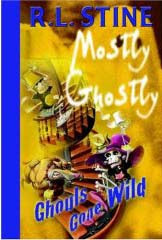
Ghouls Gone Wild? This made me laugh out loud at the library. This is officially my favourite title for a kids' book. In a very unprofessional kind of way. As this recent installation in the Mostly Ghostly series for young kids by massively popular (and prolific) author R.L. Stine made its way through the publishing process, I can't help wondering whether everyone along the way understood the porn reference. And if so, how did that conversation go? Do kids not watch late-night TV too?

A quick google search will show that Stine wasn't the first one to think up this pun, so don't get confused and start telling kids there's a movie version of this book coming out this year....

Another CM review


My review of The Royal Woods by Matt Duggan is up on CM: Canadian Review of Materials. I liked some of the messages in this story (and the explicitly Canadian setting) but wasn't wild about the book overall. Find out why...

March 29, 2007

Indigo's Star


McKay, Hilary. Indigo's Star. London, Hodder Children's Books, 2003.

McKay, Hilary. Permanent Rose. London, Hodder Children's Books, 2005.

An absent father, school bullying, shoplifting, physical disabilities, a mother who keeps keeps forgetting to shop for food and often sleeps in the garden shed, shocking news about an unknown father, a hospitalized younger sister - the makings of a serious, moving, gritty novel for children? Not at all. In this series about the inimitable Casson family, humour is the name of the game. The writing is clever, fun, and endlessly entertaining, but the topics are not always lightweight. This series of books has a particularily British sensibility, where nothing is sacred when it comes to material for humour. Even though these aren't overly controversial books, this sense of irreverence is part of the appeal.

The Casson family is quirky. The children are all named after paint colours - Permanent Rose, Indigo, Caddy (Cadmium Yellow), and Saffron. Bill Casson, their artist father, has left to live in a quiet and immaculate flat in London. Their mother, Eve Casson, isn't very domestically-inclined and spends most of her time in the garden shed painting commisioned pictures of dead pets. Saffron suntans naked behind a wall of hamsters in the back yard and beats up bullies for her younger brother Indigo. Eight year old Rose draws giant pictures on the kitchen wall and sends desperate letters to her father hoping for a crisis big enough to bring him home. Caddy has moved out but brings home a string of hopeless temporary boyfriends in an effort to decide if her real love Michael really is as perfect as everyone thinks.

The Casson family is eccentric, but not hard to identify with. Each book focuses on the story of one central character, but the ongoing storylines of the other siblings continue in the background providing continuity between the books and appeal for a wide range of ages. In Indigo's Star, for instance, twelve year-old Indigo's daily terror at the hands of school bullies is about to change forever when Tom arrives from America with his red bouncing ball and utter disregard for authority. But this central storyline is woven in, at a hectic pace, with the continuing dramas of all other members of the eccentric family.

I am not generally a fan of humorous novels (for children or adults) as I often find them a little too light-weight for my taste, but there was something about the tone of this book that I found very appealing. I enjoyed that nothing seemed out of the reaches of humour, but that real content was not sacrificed for the sake of a quick laugh. I can't help wondering whether a book like this would have come out of North America.

March 28, 2007

Dear Canada: Brothers Far From Home

I decided it was finally time for me to bite the bullet and read one of the Dear Canada books that are so popular with a particular set of girls these days. I can tell you I wasn't looking forward to it. Not only did the intensity of the series marketing make me a little ill, but the form itself (diary entries with lots of "dear reader" direct addresses) isn't, and never was, a favourite of mine. But Jean Little is no small potatoes in Canadian children's lit and I was interested to see what all the fuss was about. I must admit that I didn't have a conversion experience after which I suddenly enjoy the diary-novel, but I was impressed by what Jean Little was able to accomplish within the form. It took about a third of the book for me to stop being distracted by the format, but after that I found myself drawn into the story and eagerly waiting to see how the events of Eliza's life would unfold.

Little, Jean.
Brothers Far From Home: The World War I Diary of Eliza Bates, Uxbridge Ontario, 1916. Markham, ON: Scholastic Canada, 2003.

The year is 1916 and the Great War is the first thing on most people's minds in Uxbridge, Ontario. When twelve-year old Eliza Bates starts writing in her new Christmas diary, her biggest concern is her infuriating older sister Verity. Before she fills the final pages on Christmas day exactly two years later, Eliza will have documented the everyday trials of a family in war-time, sibling bonds and grievances, the unthinkable losses of a family with two sons away at war, and the life-affirming surprises that weave their way into even the most difficult times.

Following the template that has garnered such commercial success for the Dear Canada series, this book is told in first person diary entries, follows the life of a young Canadian girl as it is affected by events on the world stage, and is presented in a hard-cover diary-like form complete with matching ribbon bookmark. But part of the success of the series has also been Scholastic's choice of authors from among the very best of Canadian children's writers, and Jean Little is no exception.

Other than extensive research, Little's strength here is her use of character to ground the larger drama in the life of a single girl. The story's immersion in the events and flavour of the historical period is complete and convincing, but the focus is on their relevance to one family and to a single child trying to find her way through a difficult time. Eliza's character and the drama within her own family circle act as effective entry points to larger world events. The tangible and believable changes in Eliza's character over the two years also give the story a satisfying narrative arc and move the story beyond a simple tool of historical curiosity to a real coming-of-age story.

The language is noticeably more formal than a contemporary diary voice, and the diction is constant reminder of the era. The narrative makes several passing mentions of other historical events that die-hard Dear Canada fans will enjoy tracing back to other books in the series, such as the Halifax harbour explosion (No Safe Harbour: The Halifax Explosion Diary of Charlotte Blackburn, Halifax, Nova Scotia, 1917). The book also includes end-notes with more in-depth historical background and photos from the time of the First World War.

For fans of the series, or those who love to read in the diary format, this book is sure to be an instant hit. But even for those who are less convinced about the series and format, this book is well-written enough that it just may surprise some readers if they can get beyond the distraction of the form.

March 27, 2007

The Crazy Man


Porter, Pamela. The Crazy Man. Toronto: House of Anansi Press, 2005.

Farming in southern Saskatchewan has never been easy, but things go from bad to worse when a gruesome farming accident leaves twelve-year old Emaline Bitterman with a permanently injured leg, a dead dog, and a father who isn’t coming home. Unable to seed this year’s crop on her own, Emaline’s mother makes arrangements a man from the local mental institution to come help in the fields. The neighbours and townspeople are afraid of Angus, but Emaline sees another person struggling to recover from loss and family betrayal.

Unabashedly set in small-town Saskatchewan, the book offers a rich portrait of a farming community struggling to survive a period of dry weather and low wheat prices in the 1960s. The book is also steeped in the larger social and political landscape of the era, with references to Tommy Douglas, Marin Luther, King, the Wheat Board, and the Soviets.

The story doesn’t provide a happily-ever-after on the outside; instead, the narrative arc follows Emaline’s personal struggle to come to terms with her losses. Though the events of the story are difficult, the story itself is not depressing. The tone is hopeful, and the story celebrates the human ability to heal from hurt. Emaline embodies that innocent lack of prejudice often bestowed on child protagonists, but Porter manages to make this interaction convincing and utterly believable.

When someone introduced this book using the phrases “novel in verse” and “appeal for reluctant readers” in the same sentence, I have to say that I was entirely unconvinced. Once I started reading, however, I finished the story in a single sitting. It was compelling, moving and surprising easy to read. The free verse form is used here as a tool to sharpen and condense the language, heighten the emotion and point-of-view of the protagonist, and weed out any extraneous detail or description. The language isn’t “flowery” as some poetry-avoiders might fear, but whittled down to the essentials. Plot, voice, character (and even a sense of place) shine through with an immediacy that makes the book highly readable, while the short lines and 2-3 page sections make the text easier to scan.

Even though the cover is beautiful and the pages nicely designed, this book might be a hard sell to less committed readers, especially with any mention of poetry. A “novel in free verse” sounds unfortunately close to something good for your health. This is unfortunate since The Crazy Man is one of the most compelling and readable books of realistic historical fiction I’ve read. If it hadn’t already won the Governor General’s, the TD Book Award and the Geoffrey Bilson Award for Historical Fiction, I would predict a sweep of prestigious awards for this book.

The Invisible Child

Paterson, Katherine. "In Search of Wonder." In The Invisible Child: On Reading and Writing Books for Children. New York: Dutton Children's Books, 2001.

"I fed upon wonder as a child, and when I'm deprived of it, my inner life feels as sterile as a barren landscape and my outer life feels as bombarded with junk as a suburban mall."

Katherine Paterson's opening chapter is taken from a lecture on wonder that reads like a sermon without duty to any particular religion; it is a taxonomy of the different flavours of wonder - curiosity, wonder at the extraordinary, wonder at the ordinary - and an exploration of the role wonder plays in our lives, with a gentle nod towards the mystery at the core of wonder. And the bent of this talk it that children's literature, the stuff that really shines, is rich with it. Is, in fact, defined by it.

I appreciated the differentiation between the wonder at the extraordinary - the new invention, the unbelievable message in Charlotte's Web, the thrill of faster, louder, more exciting - which pales with familiarity, and the wonder at the ordinary which continues to expand and unfold with careful attention paid to even the most familiar object. Look no further than Frances Hodgson Burnett's The Secret Garden for that heightened sense of magic and wonder in what is so easily ignored.

Paterson uses the image of the spider web to talk about wonder, and visits it from different angles - from Charlotte's Web to the poetry of A.R. Ammon. I love the idea of the web as precisely patterned in the centre to reflect the species of the maker-spider, and moving out in increasing chaos towards a complete freedom to hang itself from whatever is available. Is that what children's literature aims to do? Hang itself, so improbably at times, from whatever is available while starting from a tightly woven core of wonder as individual as the maker.

This is a beautiful talk about a topic essential to any consideration of children's literature. If you haven't already - read it.

Paterson, Katherine. "Newberry Medal Acceptance Speech (1978) for Bridge to Terabithia. " In The Invisible Child: On Reading and Writing Books for Children. New York: Dutton Children's Books, 2001.

I didn't mean to start reading this speech, but suddenly I found I'd accidentally finished it and was surprised at how moved I was by the story of what this book was born out of and how it came into the world. I'm still shocked to hear that some critics find it devoid of hope simply because it deals with the unthinkable death of a child. But just as courage isn't the absence of fear but the willingness to face it, isn't hope something more than the absence of difficulty? Isn't it, in fact, something that depends of the presence of difficult circumstances for its very existence?

I was also fascinated to hear about the very substantial process of editing, to re-discover how involved a good editor can be in the act of creation. But I think what moved me the most was to hear how real the story was for the writer, and how difficult it was for her to write the difficult parts - to me this seems like the antipathy of condescension, the ultimate show of respect for the child reader.

March 14, 2007

The Thief Lord


Funke, Cornelia. The Thief Lord. The Chicken House, 2003.

Will I get kicked out of the club if I admit that I was not reading under the covers to finish this highly-acclaimed fantasy book by German kids' lit rockstar Cornelia Funke?

Let me backtrack to say that this is undoubtedly a fantastic, well-written and clearly well-loved book. And that I did enjoy it and will certainly recommend it highly. But, given all the hype, I expected to be staying up way past my bedtime and was somewhat disappointed to just enjoy it. Something about it just didn't speak to the part of me that can get absolutely lost in children's and YA fantasy. Perhaps it just isn't fair to read any book so soon after Philip Pullman's His Dark Materials trilogy.

This book centers on the story of two siblings who have run away from their nasty aunt, Esther Hartlieb, who wants to adopt only the younger five year-old Bo but not his twelve year-old brother Prosper. Not wanting to be separated, the boys run away to Venice where they meet up with a motley group of children who live in an abandoned movie theatre and are supported by the loot of the mysterious "Thief Lord."

The children soon find themselves on the run from a Victor, a determined sleuth hired by their aunt, who turns out to be more interesting than he first appears. Things get even more complicated when the secretive "Conte" hires the Thief Lord and his gang of children to steal a strange wooden wing that holds the key to unlocking the unworldly powers of an old merry-go-round.

This is the classic orphan story - exploring the world of children living without adults, the theme of age and youth, and the search for a new family in which to belong. It is highly readable, and has a giant fan-base of young readers, but somehow it failed to capture the adult reader in me that still wants to be carried away by "children's" novels. It wasn't the neatly tied-up happy ending, because I didn't wait until the end to become slightly dis-engaged, but maybe something more to do with a lack of depth and involvement in individual characters or the particular flavour of light but action-packed adventure. I'm not sure. I do have a sense, however, that this is more a matter of personal taste than a reflection of the quality of the writing.

Only Connect: Readings on Children's Literature

Egoff, Sheila, Gordon Stubbs, Ralph Ashley, and Wendy Sutton. Only Connect: Readings on Children's Literature. Toronto: Oxford University Press, 1996.

I spent some time with the Fantasy Section (Part III) of this recent Canadian classic, enjoying some different but complementary points of view on the topic from some of the best in Children's fantasy writing.

As a writer, Jane Yolen underscores the importance of research to the creation of a believable fantasy world. This includes both factual information-finding about fantastical traditions and creatures (what are the difference between Eastern and Western dragons, for instance?), as well as a cultivation of close attention to the behaviour of things in the real world with the aim of giving credibility to fantastical things in a created world. I also found her discussion of "voice" fascinating - how the choosing a vatic/prophetic/oracular voice (Wizard of Earthsea) creates a different story than one told in the schoolboy voice (Narnia), or the voice of the fool (Alice in Wonderland, Phantom Tollbooth).

Perry Nodelman challenges the idea that fantasy worlds are essentailly (or exhaustively) symbolic representations of the everyday world. He suggests that we "do not enjoy fantasies because the psychological or moral meaning." Like Yolen, he also focuses on the role of the narrator (as well as control of tone) in establishing credibility within the story. Nodelman outlines the complex relationship between the writer, the narrator (who must accept matter-of-factly the strange nature of this world whether or not it is new), the ideal implied reader (who also is familiar with the fantasy world), and the real reader (who pretends to be familiar with the unfamiliar, but who also is aware of being different). I am intrigued by this sentence: "We experience the pleasure of its otherness by pretending to not be different from it." The complex series of relationships, he suggests, is part of what contributes to the reader finding pleasure in a "conciousness of otherness."

I also liked Nodelman's assertion that the narrator "should be focused on the story, not on the world in which it occurs nor on its meaning." For me, as a sometimes-fantasy-lover, this is a big factor in whether I enjoy a fantasy or not. I don't have a lot of patience for endless description of a world or its rules if it doesn't contribute to the story. Nodelman's point helps me clarify my particular taste within this genre. I don't think, however, that this is true for all fantasy readers - I know many people who adore the very part of fantasy novels that bore me.

Tamora Pierce (and oh, how I love her) calls fantasy "a literature of possibilities" and of empowerment. She points out what seems to me to be an identifying feature of fantasy stories: the fact that "in fantasy, those normally perceived of as unimportant are vital players." I also liked that she didn't dismiss the very real value of escapism.

Chet Rayne had a very different approach to fantasy, looking at how children's imiginative and fantastical writing - more so than science fact books - helps create the "habits of mind" so crucial for scientific exploration and inquiry. Rayne see fantasy as part of the literature that supports creativity, voracious observation, and and understanding of rules and variation in rules. How lovely to think about scientific theory as a kind of fantasy - that which we cannot often see, sometimes cannot prove, and which has its own set of internal logic and rules.

Oh for a pile of good books and a deck near the ocean in the sun and a breeze off the water and a good sunhat and comfortable chair and a week without any responsibilities. Or a month, or... I can just about taste it.

March 10, 2007

New CM review

My latest review for CM is up. Check it out...

Closet inventor? Lover of cardboard? Looking for a primary school read-aloud? Gravity Buster: Journal #2 of a Cardboard Genius might be for you.

March 6, 2007

His Dark Materials


Pullman, Philip. The Golden Compass. New York: Random House, 1996.

Why has it taken me so long to read Pullman's His Dark Materials trilogy? This is fantasy at its best, the rare kind of writing that comes recommended with equal zeal from Blake scholars, adults looking for a good read, and children. This is un-put-downable, thought-provoking, beautiful writing (yes - you can have all three!).

In an alternate but parallel world, Lyra lives with the scholars of Oxford who have taken care of her since both her parents died. Or so she has always been told. A series of events lead her north to a land of snow, armoured polar bears, witches, a secret research station, and the answers to her questions about the disappearances of local children. After she discovers the horrible truth about her mother, she is determined to find her father and help him with his esoteric work involving that strange substance, the Dust, that is the source of so much conflict and fear. But she is soon to discover that the world is so much more complicated than she ever understood. And meanwhile, unbeknownst to her, everyone is watching Lyra to see if she will fulfill the destiny that has been foretold for her.

Borrowing heavily from Paradise Lost and Blake's ideas of Innocence and Experience, the story is dense and intellectually compelling while still remaining immensely readable. I'm sure I've missed more literary references than I've caught, but still I don't feel at all shut out of the story. On the contrary, this feels like an incredibly accessible book. But also the kind of book that will most surely do more for renewing current readership of Milton and Blake than any other publication in recent years (as a new edition of Paradise Lost, with forward by Pullman, will attest).

But as I make my way into the third book in the trilogy (currently and tragically on hold as homework calls), I can't help but wonder whether a book that so openly describes warring and corrupt factions of the church, and challenges ideas of religion and authority, would have come out of the United States. It was also interesting that in a story of good and evil, the sides are not easily divided - though there is clearly good, there are also many evils warring with each other, and various players will take sides with whatever faction will help them most at a moment in time. Is there more room in British publishing and culture for this kind of open and critical engagement with the world in children's literature? I like the respect that this book implies for its readership of all ages, the unwillingness to dumb-down ideas, the big questions it asks. I also like the fast pace of the action, the intricacies of plot, and the suspense that kept me reading far past my bedtime.

I'm still waiting to see where it's all heading... Excruciating to wait.

The People Could Fly

Hamilton, Virginia. The People Could Fly. Illus. Leo and Diane Dillon. New York: Knopf, 2004.

Recommended by a classmate who remembered the original story from a collection of the same name, this stand-alone illustrated version of The People Could Fly is truly an extraordinary picture book. A powerful re-telling of a mythic tale set in the days of slavery, this story begins in Africa with people who could fly but who lose their wings when they are forced onto a slave ship. When conditions become horrific on the plantation, an old man remembers the words that magically allow his people to fly again. First a woman with a baby who is beaten by the whip-wielding Driver, then a young man who collapses in the heat, and eventually the whole group of people who once had the power to fly are released by the man's magic words and escape into the sky far from the reaches of the Overseer and the plantation. Those others who could not fly are left behind, but pass the strange and miraculous story on through the generations. The paintings that illustrate the story are beautiful without shying away from the brutal history of slavery. And even amidst such explicit suffering, the story ends on a note of hope and wonder. Excerpts from the author's letter and notes, from the original collection of stories published in 1985, give additional and very interesting background information about the story and the folklore tradition from which it comes.

The unflinching but accessible language, combined with the the power of the story and the telling, make this a book that is possible to read to a younger audience but still very compelling to an older one. A winner of the Coretta Scott King Award.

The Friends


Yumoto, Kazumi. The Friends. Translated by Cathy Hirano. New York: Farrar, Straus and Giroux, 1996. [Originally published in Japanese in 1992].

When Yamashita goes to his grandmother's funeral, he is the first of the three friends to see a dead body and the event ignites a strange fascination with death for the group of friends. Following the inimitable logic of twelve-year old boys, the three friends begin spying on an old man in the hopes of catching the moment when he dies so they can all see exactly what a dead body looks like.

Kirkus Reviews (as quoted on the back cover) calls the book "a Japanese Stand By Me," and I was determined to disagree with what seemed like a glib cultural translation of a Japanese novel into something recognizable for a North American audience. But as I read the story I had to admit that there was an uncanny similarity in both the tone and content of the story. If Stand By Me was set in a Japanese city in the last summer before junior high school, and the journey took place in a series of visits (squished into the spaces between "cram school" and soccer camp) to an old man's house... There is the same playful exchange of insults between friends, conflict with the rival group of boys from school, a shared and ongoing obsession with death, enough of a sense of danger and risk to give the feeling of a journey into the unknown, and those occasional moments of honesty between boys when toughness and bravado give way to reveal closely guarded vulnerabilities and uncertainties.

What results is a quirky, moving, surprisingly gentle coming-of-age story about friendship, death, and discovery. In the midst of enormous pressure to do well on the upcoming tests that will determine what stream of junior high schools they attend, the boys begin to develop an understanding of the world that has nothing at all to do with school. Kiyama, Kawake and Yamashita are poised on the balance point between childhood and something new. As always, the inevitable changes that will soon send them in different directions are part of what make this last summer of childhood that much more poignant.

The translation feels seamless, and the prose is that rare creature which manages to be subtle, straightforward and unsentimental, yet emotionally resonant. I was unprepared to be find myself starting to cry at several small scenes in the middle of a nearby coffee shop as I read the book in a single sitting.

The descriptions of death, bodies and cremation are matter-of-fact - down to details about picking out the bones from the ashes in the crematorium with chopsticks to put them in the urn - probably more so than most North American novels for the same age group. But the idea of death is approached with that particular combination of fear and fascinated curiosity that is so recognizably that of a twelve-year old mind.

This is an amazing book - immensely readable, believable and likable. No surprise at all that it won the Batcherlder Award for translated children's books.

February 27, 2007

What-If Sara


Tregebov, Thea. What-If Sara. Illus. Leanne Franson. Toronto: Second Story Press, 1999.

Sara tries to be helpful, first with her mother's baking and then with her father's tailoring, but she can't seem to help her active imagination and busy fingers from running away on her. Only when things start to go wrong does she have the chance to prove she can rise to the challenge and help out her family. Although not the focus of the book, this story explores some of the realities of living in an immigrant family. When Sara finally does come to the rescue in the present, it is to help her father write out and deliver his bills because he has trouble with English. Even the stories that haunt her imagination - villages holding out against attacking soldiers - seem to echo the reasons a family might need to come to a new country, or the stories parents might tell to a younger generation in a new land. The layers are subtle, ringing true without feeling didactic, and the story that shines through is that of a feisty and capable young girl who uses her imagination to help save the day. The watercolour illustrations bring Sara's imagination to life, separating old world imagining from everyday activities by using a muted colour scheme for the village scenes (except for Sara and her ubiquitous companion cat), and a border of dough or thread to indicated the object into which her active mind has thrown itself.

Mrs. Katz and Tush


Polacco, Patricia. Mrs. Katz and Tush. New York: Bantam, 1992.

Larnel doesn't know much about his neighbour, Mrs. Katz, except that she's lonely. But when Larnel brings her a stray kitten from the basement of their building, the cat becomes a catalyst for an unlikely friendship between the young African-American boy and the older Jewish woman. After a crisis involving a runaway cat, Mrs. Katz invites Larnel for a Passover dinner. The narrative uses the story of Passover, which focuses on seeking freedom from slavery, to underline some of the similarities between Jewish and African-American history. The illustrations are colourful and lively, with great attention paid to the detail and expressiveness of individual faces.